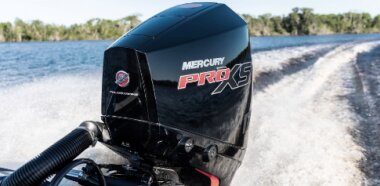
Yamaha T50TLR Specifications
| Engine Model: Yamaha T50TLR |
| Engine Type: 4-stroke inline 4-cylinder OHC 8-valve gasoline outboard engine |
| Total Displacement: 57.1 cu.in (935 cc) |
| Rated Engine Power: 50 Hp (36.8 kW) at 5500 rpm |
| Fuel System: Carburetors |
____________________________________________________________________________________
The Yamaha T50TLR is a 50-horsepower,
four-stroke, in-line four-cylinder outboard engine from Yamaha's High
Thrust series, specifically engineered for displacement hulls and heavy
workboat applications. This model is configured for remote control
operation and is equipped with electric starting and a hydraulic power
trim and tilt system, offering boaters a purpose-built power source
optimized for maximum thrust and maneuverability.
Built on a robust 935cc platform, the T50TLR is renowned for its
exceptional low-end torque, superior reverse thrust, and the durability
of its High Thrust lower unit, making it a dependable and powerful
choice for sailboats, pontoon boats, and commercial craft.
The Yamaha T50TLR is constructed around a specialized powerhead and
lower unit combination. It features a 4-stroke, OHC, in-line 4-cylinder,
8-valve engine configuration. The engine displacement is precisely 935
cc (57.1 cu in) , achieved through a bore and stroke of 63.0 mm x 75.0
mm (2.48 in x 2.95 in).
This powerhead produces a maximum output of 36.8 kW (50 hp) at 5,500
rpm. The engine is engineered to operate within a full throttle
operating range of 5,000 to 6,000 rpm, with a compression ratio of
9.3:1. Maximum fuel consumption is 17.3 L (4.57 US gal, 3.81 Imp gal)/hr
at 6,000 rpm.
The power unit of the T50TLR is engineered for durability and efficient
combustion. The cylinder head utilizes a cross-flow design with the
intake valves positioned on one side and exhaust valves on the other.
The valve train requires periodic adjustment, with specified valve
clearances of 0.15-0.25 mm (0.006-0.010 in) for the intake valves and
0.25-0.35 mm (0.010-0.014 in) for the exhaust valves. The cylinder head
incorporates a two-step torque procedure for proper sealing.
The T50TLR features a carburetor fuel system with four individual
carburetors (one per cylinder) for precise fuel metering. The
recommended fuel is regular unleaded gasoline with an octane rating of
86-91. The engine is supplied with fuel from a separate tank.
The lubrication system is a wet sump type, meaning the engine oil is
stored in a sump within the engine. The recommended engine oil is
high-quality 4-stroke motor oil in SAE 10W-30, 10W-40, or 20W-40
viscosities, meeting API SE, SF, SG, or SH service classifications. The
engine oil capacity with oil filter replacement is 2.2 L (2.3 US qt, 1.9
Imp qt).
The cooling system is raw-water with thermostatic control, drawing water
from the body of water to cool the engine. A freshwater flushing device
is integrated for easy maintenance. Exhaust gases are expelled through
the propeller boss for efficient underwater exhaust and noise reduction.
The ignition system is a microcomputer-controlled CDI (Capacitor
Discharge Ignition) unit, providing precise spark timing for reliable
starting and efficient power across the RPM range. The ignition timing
advances from 5 ± 3 degrees BTDC to 35 ± 3 degrees BTDC as engine speed
increases.
The system includes the Prime Start enrichment feature for effortless
cold starts. The specified spark plugs are NGK DPR6EA-9, with a required
gap of 0.8-0.9 mm (0.031-0.035 in). The charging system incorporates an
alternator output of 12V, 10A with a built-in rectifier/regulator to
maintain battery charge for the electric start and other electrical
accessories.
| Mid Section and Lower Unit |
The lower unit is specifically engineered as a High Thrust model,
featuring a larger gear case and a special low-pitch propeller to
maximize pulling power and reverse thrust. It uses a spiral bevel gear
with a reduction gear ratio of 2.33:1 (28/12) , which is lower than
standard models to provide exceptional torque and acceleration for
pushing heavy loads.
The gear shift positions are the standard Forward-Neutral-Reverse
(F-N-R), engaged via a positive-action dog clutch. The propeller shaft
utilizes a spline drive system, and the propeller direction, when viewed
from the rear, is clockwise. The correct lubricant for the lower unit is
hypoid gear oil meeting API GL-4 SAE 90 specifications, with a gear oil
capacity of 0.61 L (0.64 US qt, 0.54 Imp qt).
This outboard is equipped with a hydraulic power trim and tilt system,
allowing for effortless adjustment of the engine angle with the touch of
a button. The trim angle can be adjusted through a wide range, from -4
degrees to +20 degrees , enabling the operator to fine-tune the boat's
attitude for optimal performance and fuel efficiency under various load
and water conditions.
Negative trim angles help keep the bow down for improved visibility and
control in following seas. For shallow water operation and trailering,
the system provides a maximum tilt-up angle of 69 degrees. The steering
angle is 40 degrees to both port and starboard.
The Yamaha T50TLR is equipped with specially designed High Thrust
propellers to maximize the engine's low-end torque and reverse thrust
capabilities. The available K Aluminum propeller options include various
sizes tailored for different applications. These include: 12-5/8 x 21,
13 x 19, 13 x 23, 13 x 25, 13-1/4 x 17, 13-1/2 x 15, 13-5/8 x 13, and 14
x 11.
The Yamaha T50TLR is designed as a long shaft model. The overall length
is 718 mm (28.3 in) and the overall width is 361 mm (14.2 in). The
overall height is 1,436 mm (56.5 in) with a transom height of 508 mm
(20.0 in). The dry weight for this model is 112 kg (247 lb).
Regular maintenance is essential for the longevity of the T50TLR. The
engine oil and oil filter should be changed according to the
manufacturer's schedule, with the oil drain plug and oil filter torque
specified at 18 Nm (13 lb-ft) each. The gear oil in the lower unit
should be checked regularly for the presence of water or metal particles
and changed annually or every 100 hours.
The water pump impeller is a wear item that should be inspected and
replaced periodically, every 1-2 years or if there are signs of reduced
cooling water flow, to prevent overheating. The spark plugs should be
removed, inspected, cleaned, and the gap adjusted annually, and replaced
as needed.
Valve clearance inspection and adjustment should be performed at
recommended intervals. All moving parts, such as steering linkages and
tilt tube, require regular greasing with water-resistant marine grease
to prevent corrosion and ensure smooth operation.
Cylinder head bolt (M6, 1st step): 6 Nm (4.3 lb-ft)
Cylinder head bolt (M6, 2nd step): 12 Nm (8.7 lb-ft)
Cylinder head bolt (M9, 1st step): 23 Nm (17 lb-ft)
Cylinder head bolt (M9, 2nd step): 47 Nm (34 lb-ft)
Crankcase bolt (M6, 1st step): 6 Nm (4.3 lb-ft)
Crankcase bolt (M6, 2nd step): 12 Nm (8.7 lb-ft)
Crankcase bolt (M8, 1st step): 15 Nm (11 lb-ft)
Crankcase bolt (M8, 2nd step): 30 Nm (22 lb-ft)
Connecting rod cap bolt (1st step): 6 Nm (4.3 lb-ft)
Connecting rod cap bolt (2nd step): 17 Nm (12 lb-ft)
Flywheel magnet nut: 160 Nm (116 lb-ft)
Oil pressure switch: 9 Nm (6.5 lb-ft)
Ignition coil bolt (M6): 7 Nm (5.1 lb-ft)
Starter motor bolt (M8): 30 Nm (22 lb-ft)
Power unit bolt (M8): 21 Nm (15 lb-ft)
Spark plug: 18 Nm (13 lb-ft)
Oil filter: 18 Nm (13 lb-ft)
Oil drain bolt: 18 Nm (13 lb-ft)
Lower unit bolt (M10): 40 Nm (29 lb-ft)
Propeller nut: 35 Nm (25 lb-ft)
The Yamaha T50TLR is a specialized power source ideally suited for boats
where thrust and maneuverability are paramount over speed. Its High
Thrust lower unit and low gear ratio make it a perfect match for
displacement hulls, including sailboats as an auxiliary power source,
where the ability to push through wind and current is essential.
It is also an excellent choice for pontoon boats and deck boats,
providing the torque needed to get these large, heavy platforms on plane
and maintain control at slow speeds. Commercial applications include
workboats, patrol boats, and other vessels where dependable, low-speed
power and exceptional reverse thrust are required for docking and
maneuvering in tight quarters.
____________________________________________________________________________________
| Outboard Engines Technical Specifications |
| Small Engines Technical Specifications |
| Car Engines Technical Specifications |
| Industrial Engines Technical Specifications |