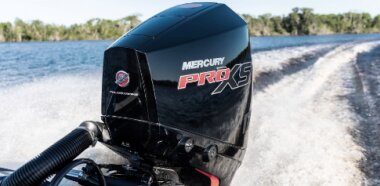
Yamaha F70AET Specifications
| Engine Model: Yamaha F70AET |
| Engine Type: 4-stroke inline 4-cylinder SOHC 16-valve gasoline outboard engine |
| Total Displacement: 60.8 cu.in (996 cc) |
| Rated Engine Power: 70 Hp (51.5 kW) at 5800 rpm |
| Fuel System: Electronic Fuel Injection (EFI) |
____________________________________________________________________________________
The Yamaha F70AET is a 70-horsepower,
four-stroke outboard engine that delivers exceptional power-to-weight
performance within a remarkably lightweight package, establishing a new
benchmark in the 70hp category. This model is distinguished by its
16-valve, inline four-cylinder powerhead, electronic fuel injection, and
power trim and tilt, providing operators with responsive acceleration,
quiet operation, and precise control over boat attitude for optimized
handling and fuel efficiency.
The F70AET is built upon a proven 996cc platform, delivering smooth,
reliable power across the entire rpm range, making it exceptionally
versatile for a wide variety of recreational and semi-commercial
applications, from aluminum fishing boats to small center consoles and
pontoon boats.
Its advanced four-stroke design ensures cleaner operation with reduced
emissions, while features like Prime Start, high-output alternator, and
shallow water drive enhance user convenience and expand operational
capabilities. The engine is equipped with the Yamaha Security System
(Y-COP) as an optional feature to protect against theft.
The Yamaha F70AET is a 4-stroke, Single Overhead Camshaft (SOHC), inline
4-cylinder engine featuring a 16-valve configuration with four valves
per cylinder. The total displacement is 996 cc (60.8 cu.in), achieved
through a bore and stroke of 65.0 mm (2.56 inches) and 75.0 mm (2.95
inches), respectively.
It produces a maximum prop shaft output of 51.5 kW, equivalent to 70
horsepower, at 5,800 rpm. The engine has a full throttle operating range
of 5,300 to 6,300 rpm. The idle speed is set between 700 and 800 rpm.
The compression ratio is 9.4:1.
The powerhead is built upon a robust cylinder block designed for
longevity and smooth operation. The cylinder head incorporates a Single
Overhead Camshaft (SOHC) operating four valves per cylinder - two intake
and two exhaust - for optimized breathing and combustion efficiency,
contributing to the engine's exceptional power output relative to its
displacement.
The valve clearances are critical for performance and must be maintained
within specified ranges. The intake valve clearance is set to 0.15-0.25
mm (0.006-0.010 inches), while the exhaust valve clearance is set to
0.25-0.35 mm (0.010-0.014 inches). The power unit is equipped with a
microcomputer-controlled ignition and fuel injection system that
maintains optimal performance across a wide range of operating
conditions.
The fuel system is a sophisticated Electronic Fuel Injection (EFI)
system with multi-point injection, managed by a reliable microcomputer
module that controls fuel delivery for clean and efficient performance.
This system automatically adjusts the fuel mixture for varying
conditions, ensuring optimal combustion and fuel efficiency. The Prime
Start system provides effortless starting, comparable to starting an
automobile, by automatically enriching the fuel mixture when starting.
The engine operates on regular unleaded gasoline with a minimum octane
rating of 86 RON. A standard remote fuel tank has a capacity of 25.0
liters (6.6 US gallons). The fuel system incorporates a water-separating
fuel filter with an integrated alarm that activates when water exceeds
acceptable levels, protecting the engine from water contamination.
The F70AET utilizes a wet sump lubrication system, meaning engine oil is
contained within a sump in the powerhead. The recommended engine oil is
high-quality 4-stroke outboard motor oil, with Yamalube being the
preferred brand.
Acceptable oil types include SAE 10W-30 or 10W-40 viscosities that meet
API service classifications SE, SF, SG, SH, SJ, or SL. The total engine
oil capacity is 2.5 liters total, with 2.1 liters required when
replacing the oil filter and 1.9 liters without filter replacement
during routine maintenance.
Cooling is managed by a raw-water system with a thermostat, circulating
water through passages in the engine block and cylinder head. A water
pump, driven by the drive shaft, draws water from outside the boat and
forces it through the engine to maintain optimal operating temperatures.
The thermostat helps maintain acceptable cylinder temperatures across a
wide range of engine speeds.
A pilot water outlet on the engine exterior provides a visual indication
that the water pump is functioning and cooling water is circulating
properly. A fresh water flushing system is integrated into the design,
facilitating easy removal of salt and debris after operation in marine
environments.
| Mid Section and Lower Unit |
The exhaust system is designed to expel gases through the propeller hub
for quieter operation and reduced back pressure. The gear shift
positions are forward, neutral, and reverse. The gear ratio is 2.33:1,
derived from a 28/12 gear set, providing excellent torque multiplication
for rapid acceleration and improved performance with heavier loads.
The reduction gear type is spiral bevel gear, and the clutch is a dog
type, providing positive engagement. The propeller shaft utilizes a
spline drive system for secure propeller mounting, and the propeller
rotation, when viewed from the rear, is clockwise in forward gear. The
gear case requires hypoid gear oil meeting API GL-4 SAE 90 standards,
with a total capacity of 0.67 liters (0.70 US quarts).
The engine is equipped with a power trim and tilt system (Negative Power
Trim and Tilt), providing full, relaxed control over the engine's angle
relative to the transom. The trim angle is adjustable within a range of
-4 to +16 degrees for a 12-degree transom, allowing operators to
optimize boat attitude for acceleration, fuel economy, and ride comfort
under varying load and water conditions. The tilt-up angle is 65
degrees.
The system also features a shallow water drive capability, allowing the
engine to be quickly tilted and operated at a shallower angle for safe
navigation through shallow water without striking the bottom. An
optional tilt limiter system can be installed to prevent the engine from
tilting beyond a preset point when operating in reverse or around
obstacles. The steering angle is 40 degrees in both directions.
Selecting the correct propeller is essential for achieving optimal
engine performance within the recommended full throttle operating range.
The Yamaha F70AET utilizes a spline drive system with a keyway
specification (Propeller mark K) and is designed to run with a wide
selection of aluminum and stainless steel propellers.
The appropriate propeller allows the engine to operate at or near the
top of its 5,300-6,300 rpm full throttle range when the boat is properly
loaded. Propeller markings indicate the diameter and pitch in inches.
The comprehensive rigging guide provides detailed propeller
specifications and selection charts for various applications.
The overall length of the outboard is 698 mm (27.5 inches). The overall
width is 386 mm (15.2 inches). The overall height for the long shaft
model, designated for a 20-inch transom, is 1,476 mm (58.1 inches), with
a corresponding transom height of 534 mm (21.0 inches). An extra-long
shaft version (X) is available with an overall height of 1,590 mm and
transom height of 648 mm (25.5 inches).
The dry weight for the long shaft version is 119 kg (262 lbs), making it
the lightest engine in its power class and particularly attractive for
vessels where weight distribution is a concern. The extra-long shaft
version weighs approximately 123 kg (270 lbs).
Routine maintenance is essential for optimal performance and longevity.
The engine is equipped with a TCI (Transistor Controlled Ignition)
ignition system with microcomputer control, which provides precise spark
timing without moving parts for reliable, maintenance-free operation.
The alternator output is a robust 12V - 15A or 17A system with a
rectifier/regulator to maintain proper battery charging, with 9A
dedicated to battery charging capacity.
The standard spark plug for the F70AET model is an NGK LKR7E. The spark
plug gap must be maintained between 0.8 and 0.9 mm (0.031 to 0.035
inches). Maximum fuel consumption at 5,800 rpm is approximately 21.2
liters per hour. The engine is compatible with Yamaha's digital network
gauges, allowing operators to monitor critical engine parameters
including speed, fuel management, and engine hours in real time.
The maintenance schedule includes key services at initial break-in, 50
hours, 100 hours, and annual intervals. Items requiring periodic
attention include the valve clearance, which must be inspected and
adjusted by qualified personnel using feeler gauges. The operator sound
pressure level measured according to ICOMIA 39/94 standards is 83.9
dB(A).
The Variable Trolling RPM feature, operated via a switch on the remote
control box, allows for precise speed control at low speeds for trolling
applications. A recommended battery specification includes cold cranking
A of 430-1080A (CCA/EN) with a minimum rated capacity of 70 Ah
(20HR/IEC).
Adhering to correct torque specifications is critical during assembly
and maintenance to ensure proper sealing, component retention, and safe
operation. The spark plug must be torqued to 17 Nm (12.5 lb-ft) to
ensure proper seating without damaging the cylinder head threads.
The propeller nut, which secures the propeller to the propeller shaft,
requires 34 Nm (25.1 lb-ft). The engine oil drain plug must be tightened
to 27 Nm (19.9 lb-ft) to prevent leaks while allowing future removal.
The oil filter requires 18 Nm (13.3 lb-ft) for proper sealing against
its mounting surface. Additional torque specifications for critical
fasteners are documented in the official service manual.
The Yamaha F70AET is intended for use on boats where the total
horsepower does not exceed the vessel's maximum rated power capacity, as
indicated on the boat's capacity plate. Its 70-horsepower output makes
it suitable for a wide range of boats, including aluminum fishing boats,
utility skiffs, pontoons, small center-console vessels, and as auxiliary
power for larger sailboats. The engine has been documented in
applications such as the Buster X bowrider and Polocraft Trident 20,
demonstrating its versatility across different hull types.
The long shaft configuration is specifically designed for boats with a
20-inch transom, while the extra-long shaft version accommodates 25-inch
transoms. Proper installation, including correct remote control cable
adjustment and battery selection, is essential to ensure safe handling
and prevent loss of control. As with all outboards, operators must
always ensure the engine stop switch lanyard is attached to a secure
part of their clothing or life jacket.
____________________________________________________________________________________
| Outboard Engines Technical Specifications |
| Small Engines Technical Specifications |
| Car Engines Technical Specifications |
| Industrial Engines Technical Specifications |