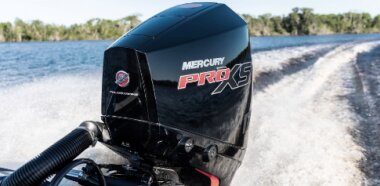
Yamaha 30HWCS Specifications
| Engine Model: Yamaha 30HWCS |
| Engine Type: 2-stroke 2-cylinder gasoline outboard engine |
| Total Displacement: 30.2 cu.in (496 cc) |
| Rated Engine Power: 30 Hp (22.1 kW) at 5500 rpm |
| Fuel System: Carburetor |
____________________________________________________________________________________
The Yamaha 30HWCS is a 30-horsepower,
two-cylinder, two-stroke outboard motor from Yamaha, representing a
versatile and popular choice for small boat owners. This model is
distinguished by its dual-start capability, offering both manual recoil
and electric starting, which provides added convenience for a wide range
of users. The engine is built on a proven powerhead architecture
utilizing a loop-charged scavenging system.
This design promotes efficient fuel delivery and exhaust scavenging by
creating a swirling motion of the air-fuel mixture within the cylinders,
leading to improved combustion efficiency and power output. The Yamaha
30HWCS is available with a tiller handle or can be adapted for remote
control operation, and its lightweight, compact construction makes it an
ideal power source for fishing boats, inflatables, skiffs, and light
commercial craft.
Engine type: 2-stroke, L.
Number of cylinders: 2.
Total displacement: 496 cc (30.27 cu in).
Bore and stroke: 72.0 x 61.0 mm (2.83 x 2.40 in).
Maximum output: 22.1 kW (30 hp) at 5,000 rpm.
Full throttle operating range: 4,500-5,500 rpm.
Engine idle speed: 1,050-1,150 rpm.
Compression ratio: 7.0:1.
Fuel system: Carburetor.
Intake system: Reed valve.
Scavenging system: Loop charge.
Ignition system: CDI.
Starting system: Manual or electric.
Control system: Tiller or remote control.
Alternator output: 12V, 6A (80W).
Starting enrichment: Choke valve.
Spark plug: NGK B8HS-10 or NGK BR8HS-10.
Cooling system: Water.
Exhaust system: Through propeller hub.
Lubrication system: Pre-mixed fuel and oil.
Recommended fuel: Regular unleaded gasoline (minimum 92 octane).
Recommended oil: 2-stroke outboard motor oil, NMMA-certified TC-W3.
Oil-fuel ratio: 50:1.
Gear oil type: Hypoid gear oil.
Gear oil grade: API GL-4 SAE 90.
Gear oil capacity: 0.32 L (0.34 US qt).
Gear ratio: 2.08 (27/13).
Gear shift positions: Forward - Neutral - Reverse.
Reduction gear type: Spiral bevel gear.
Clutch type: Dog clutch.
Propeller shaft type: Spline.
Propeller direction (rear view): Clockwise.
Trim angle positions: 4, 8, 12, 16, 20 degrees.
Tilt-up angle: 76 degrees.
Steering angle: 40 + 40 degrees.
Propeller size (options): 9-7/8 x 8, 9-7/8 x 9, 9-7/8 x 10, 9-7/8 x
10-1/2, 9-7/8 x 11-1/4, 9-7/8 x 12, 9-7/8 x 13, 9-7/8 x 14 (in).
The Yamaha 30HWCS features a durable cylinder block and powerhead
assembly constructed to withstand the rigors of marine use. The cylinder
bore has a precision inside diameter ranging from 72.000 to 72.020 mm
(2.8346 to 2.8354 in). The cylinder head is manufactured to tight
tolerances, with a maximum allowable warpage limit of 0.1 mm (0.0039
in), ensuring a leak-proof seal and consistent compression when
assembled correctly.
The crankshaft is constructed from hardened materials for long life,
with a crankpin diameter of 23.995 to 24.000 mm (0.9447 to 0.9449 in).
Pistons are precisely matched to the cylinders, with a piston diameter
of 71.935 to 71.960 mm (2.8321 to 2.8331 in). The piston pin outside
diameter measures 19.895 to 19.900 mm (0.7833 to 0.7835 in). Connecting
rod specifications include a small-end inside diameter of 23.904 to
23.917 mm (0.9411 to 0.9416 in) and a big-end inside diameter of 32.000
to 32.016 mm (1.2598 to 1.2605 in).
The connecting rod big-end side clearance is maintained between 0.200
and 0.700 mm (0.0079 to 0.0276 in). The powerhead incorporates a reed
valve intake system, which acts as a one-way check valve to optimize
air-fuel flow into the crankcase. The loop-charge scavenging system
enhances combustion efficiency by directing the fresh charge in a loop
to push out exhaust gases.
Piston ring fit is essential for maintaining compression and controlling
lubrication. The top ring has an end gap tolerance of 0.20 to 0.35 mm
(0.0079 to 0.0138 in) and a side clearance of 0.02 to 0.06 mm (0.0008 to
0.0024 in). The second ring similarly has an end gap of 0.20 to 0.35 mm
(0.0079 to 0.0138 in) and a side clearance of 0.03 to 0.07 mm (0.0012 to
0.0028 in).
These precise clearances allow for thermal expansion during operation
while maintaining an effective seal against the cylinder wall to
maximize power and efficiency. Verification of these dimensions is
critical during any rebuild or top-end service to ensure proper engine
performance and longevity.
The Yamaha 30HWCS utilizes a single-carburetor fuel system. The
carburetor is responsible for atomizing fuel and mixing it with incoming
air in the correct ratio for combustion across the engine's operating
range. The system includes a fuel filter requiring periodic inspection
and cleaning to prevent contaminants from entering the carburetor.
Starting enrichment is achieved through a manual choke valve, which
restricts air intake to provide a richer fuel mixture for reliable cold
starts.
The carburetor incorporates a float chamber with a float and needle
valve to maintain a consistent fuel level. Adjustment of the carburetor
idle mixture screw and idle speed setting may be required to compensate
for changes in altitude or seasonal temperature variations, ensuring the
engine runs smoothly and efficiently. The engine comes standard with a
24-liter external fuel tank.
Lubrication for the Yamaha 30HWCS is provided by a pre-mix system,
requiring the operator to mix two-stroke oil directly with the gasoline
in the fuel tank. The recommended oil is a high-quality, NMMA-certified
TC-W3 two-stroke outboard oil, which is formulated to burn cleanly and
provide adequate lubrication for the crankshaft bearings, connecting rod
bearings, and cylinder walls.
The standard fuel-oil mixture ratio for break-in and normal operation is
50:1. Proper mixing is essential; oil should be thoroughly mixed with
fuel, preferably in a separate mixing container before filling the fuel
tank, to prevent engine damage from insufficient lubrication. This
pre-mix design simplifies the engine by eliminating an oil injection
pump and associated components, enhancing reliability and reducing
maintenance requirements.
The cooling system is a raw-water, thermostatically controlled design. A
water pump, driven by the driveshaft, draws water from the body of water
through an inlet in the lower unit. This water is then circulated
through water jackets within the cylinder block and cylinder head to
absorb combustion heat. A thermostat regulates coolant flow, allowing
the engine to reach and maintain optimal operating temperature quickly.
Once the engine warms up, the thermostat opens, allowing full water flow
to prevent overheating. An important maintenance practice is to flush
the cooling system with fresh water after operating the engine in salt,
muddy, or polluted water to remove deposits and debris that could block
passages and cause overheating. The cooling system includes a pilot
water tell-tale, providing a visual indication that the water pump is
functioning and water is circulating through the engine.
| Mid Section and Lower Unit |
The mid section houses the exhaust tube and drive shaft, connecting the
powerhead to the lower unit. The lower unit contains the reduction
gearing and propulsion components. The gear ratio is 2.08:1, achieved
with a pinion gear and forward gear set of 27/13 teeth. The reduction
gears are of the spiral bevel type, chosen for their strength and
smoothness of operation.
The clutch mechanism is a dog clutch, which engages and disengages the
gears for shifting. Gear shift positions are forward, neutral, and
reverse. The propeller shaft is splined to accept a range of propeller
options. The lower unit housing is constructed from corrosion-resistant
materials and includes sacrificial anodes to protect against galvanic
corrosion. The propeller direction, when viewed from the rear of the
boat, is clockwise for forward operation.
The gear housing is filled with hypoid gear oil meeting API GL-4 SAE 90
specifications, with a total capacity of 0.32 L (0.34 US qt). Regular
inspection and periodic changing of the gear oil are necessary to detect
water ingress or metal particles indicating internal wear.
The Yamaha 30HWCS features a manual trim and tilt system, allowing the
operator to adjust the engine angle relative to the boat transom. The
system uses a series of pin positions on the tilt bracket to set the
trim angle. Five distinct trim angle positions are provided: 4, 8, 12,
16, and 20 degrees. Correct trim adjustment affects boat performance;
trimming the engine in helps the boat plane and improves handling in
rough water, while trimming out can increase top speed and efficiency on
calm water.
For shallow water operation or when trailering, the engine can be
manually tilted up to a maximum angle of 76 degrees. The system also
allows for shallow water drive operation, where the engine is partially
tilted to navigate through shallows while still providing propulsion.
The steering angle is 40 degrees in both directions, providing good
maneuverability at low speeds.
Selecting the correct propeller is critical for maximizing the
performance and efficiency of the Yamaha 30HWCS. The engine is designed
to operate within its full throttle rpm range of 4,500 to 5,500. The
propeller pitch must be chosen so that, with a normal boat load, the
engine reaches the upper half of this range at full throttle. Yamaha
offers a range of genuine aluminum propellers for the 30HWCS, all with a
9-7/8 inch diameter. Available pitch options include 8, 9, 10, 10-1/2,
11-1/4, 12, 13, and 14 inches.
A lower pitch propeller, such as the 9-7/8 x 8, provides quicker
acceleration and more power for planing heavy loads or for use on
heavier boats. A higher pitch propeller, such as the 9-7/8 x 14, is
suited for lighter boats where higher top speed is desired. The
propeller nut must be tightened to the specified torque to secure the
propeller properly and prevent damage to the thrust washer or propeller
hub.
Overall length: 843 mm (33.2 in)
Overall width: 399 mm (15.7 in)
Overall height (short shaft): 1,146 mm (45.1 in)
Transom height (short shaft): 381 mm (15.0 in)
Weight (short shaft): 56.5 kg (125 lb)
After first 10 hours or 1 month: Check and adjust carburetor
synchronization and ignition timing. Retighten all cylinder head bolts,
crankcase bolts, and engine mounting bolts. Change gear oil. Every 50
hours or 3 months: Inspect and clean spark plugs. Check and clean fuel
filter. Inspect fuel lines and primer bulb for cracks or damage. Check
gear oil for water contamination and change if necessary. Lubricate all
control linkages and moving parts.
Every 100 hours or 6 months: Clean and adjust spark plugs. Clean cooling
water passages and inspect thermostat operation. Check condition of
sacrificial anodes on engine and lower unit. Check and adjust carburetor
settings.
Every 200 hours or 1 year: Replace spark plugs. Replace water pump
impeller. Inspect and clean entire fuel system, including carburetor.
Check and adjust reed valve condition. Replace fuel lines if hardened or
cracked. Perform a thorough check of all electrical connections and
controls. Every 3 years: Consider replacement of the water pump housing
and kit if not done earlier. Inspect and repack or replace steering
cable and tilt tube bushings.
Starter nut: 10 Nm (7.2 lb-ft)
Drive plate bolt: 15 Nm (11.1 lb-ft)
Starter mount bolt: 12 Nm (8.9 lb-ft)
Power unit mount bolt: 22 Nm (16.2 lb-ft)
Flywheel magnet nut: 140 Nm (103 lb-ft)
Reed valve stopper nut: 4.5 Nm (3.3 lb-ft)
Cylinder head bolt (1st step): 15 Nm (11.1 lb-ft)
Cylinder head bolt (2nd step): 27 Nm (19.9 lb-ft)
Crankcase bolt (1st step): 15 Nm (11.1 lb-ft)
Crankcase bolt (2nd step): 27 Nm (19.9 lb-ft)
Spark plug: 25 Nm (18 lb-ft)
Lower case mount bolt (nut): 37 Nm (27.3 lb-ft)
Cooling water inlet cover screw: 4 Nm (3.0 lb-ft)
Propeller nut: 35 Nm (25.3 lb-ft)
Propeller housing bolt: 11 Nm (8.1 lb-ft)
Steering bracket bolt: 11 Nm (8.1 lb-ft)
Float pin screw: 2 Nm (1.5 lb-ft)
Float chamber screw: 2 Nm (1.5 lb-ft)
The Yamaha 30HWCS is a versatile power option for a diverse range of
small craft. Its lightweight and compact size make it ideal for
inflatable boats and rigid-hull inflatable boats used in recreational,
rescue, and light commercial applications. Small fishing boats,
including jon boats, aluminum skiffs, and semi-V hulls, are well-suited
to the 30HWCS's power-to-weight ratio, allowing for easy planing and
efficient cruising. The electric start feature adds convenience for
boaters who frequently start and stop their engine during fishing or
watersports activities.
The engine is also commonly found on small pontoon boats, dinghies used
as yacht tenders, and light utility craft in aquaculture and inland
waterway maintenance. The availability of both tiller and remote control
configurations allows the 30HWCS to be adapted to various boat layouts
and operator preferences, from simple tiller-steered fishing boats to
more complex center-console vessels with dual controls.
____________________________________________________________________________________
| Outboard Engines Technical Specifications |
| Small Engines Technical Specifications |
| Car Engines Technical Specifications |
| Industrial Engines Technical Specifications |