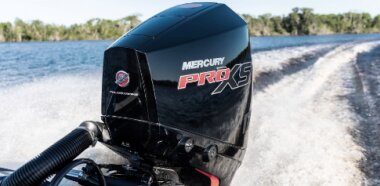
Suzuki DF6A Specifications
| Engine Model: Suzuki DF6A |
| Engine Type: 4-stroke 1-cylinder OHV gasoline outboard engine |
| Total Displacement: 8.4 cu.in (138 cc) |
| Rated Engine Power: 6 Hp (4.4 kW) at 5750 rpm |
| Fuel System: Carburetor |
____________________________________________________________________________________
The Suzuki DF6A is recognized for its
significant reduction in weight compared to its predecessor, enhancing
its portability for users who frequently transport and store their
engine. Weighing as little as 24.0 kg in its short-shaft version, it
incorporates design elements that improve the user experience, such as a
well-placed carrying handle and a redesigned fuel system. The integrated
one-liter fuel tank is positioned above the carburetor, allowing for
gravity feed and easier starting after the engine has been stored.
Its operation is noted for a smooth idle, linear power delivery, and
reduced vibration at the tiller, particularly in the mid-range. The
engine is built with Suzuki's anti-corrosion system for durability in
marine environments and includes features like a digital CDI ignition
for reliable starting and an over-revolution limiter for protection. As
a four-stroke, it offers cleaner operation and greater fuel efficiency
compared to traditional two-stroke engines.
Engine Model: Suzuki DF6A
Engine Type: 4-stroke single-cylinder OHV gasoline outboard engine
Number of Cylinders: 1
Displacement: 138 cc (8.42 cu-in)
Cylinder Bore: 60.4 mm (2.38 in)
Piston Stroke: 48.0 mm (1.89 in)
Maximum Engine: Power 4.4 kW (6.0 hp)
Full Throttle Operating Range: 4750 - 5750 r/min
Idle Speed: 1250 - 1350 r/min
Fuel System Type: Carburetor
Fuel Type: Unleaded gasoline (91 octane minimum)
Ignition System: Digital CDI
Cooling System: Water-cooled with thermostat
Exhaust System: Through propeller hub
Starting System: Manual
Choke System: Manual
Gear Shift: Forward - Neutral - Reverse
Gear Ratio: 1.92:1
Steering System: Tiller
Trim and Tilt System: Manual, 5-position tilt pin
Transom Height (Short): 381 mm (15 in)
Transom Height (Long): 508 mm (20 in)
Dry Weight (Short Shaft): 24.0 kg (52.8 lbs)
Dry Weight (Long Shaft): 25.0 kg (55.0 lbs)
The powerhead is built around a single-cylinder configuration with a
displacement of 138 cc. It utilizes an OverHead Valve (OHV) design with
two valves per cylinder, one for intake and one for exhaust. A notable
engineering feature is the offset cylinder design, where the crankshaft
is positioned slightly off the center of the cylinder bore. This reduces
the lateral force (side thrust) of the piston against the cylinder wall
during the power stroke.
The result is smoother piston movement, reduced friction, and enhanced
operational efficiency. The valve train is designed for quiet operation,
with engineering refinements to the rocker arm structure to minimize
excessive movement and noise. The cylinder head is secured with bolts
that require a precise tightening torque of 21.7 lbf-ft (30 Nm) during
service or reassembly. Valve lash, critical for proper engine timing and
noise control, is set to 0.13-0.17 mm (0.005-0.007 in) for both the
intake and exhaust valves.
The DF6A features a straightforward and reliable fuel delivery system
centered on a carburetor. A mechanical fuel pump draws fuel from either
the built-in 1.0-liter tank or an optional external remote tank,
selected via a changeover cock on the engine. A significant upgrade in
this model is the positioning of the integral fuel tank.
Mounted high on the engine, it allows gravity to feed fuel to the
carburetor. This design eliminates the need for a primer bulb to re-fuel
the system after the engine has not been used for a while, simplifying
the starting procedure. A manual choke is provided for cold starts. The
fuel system also includes a fuel filter that requires periodic
inspection and replacement to ensure contaminant-free operation.
The lubrication system is a trochoid pump-driven forced system, a design
that enhances reliability. It is engineered to deliver a steady supply
of oil under pressure to critical engine components, including the upper
crankshaft bearing and the big end of the connecting rod, reducing wear
and aiding in cooling. A noteworthy feature in this class of outboard is
the inclusion of a replaceable, cartridge-style oil filter, which
significantly improves the system's long-term reliability by trapping
contaminants.
An oil level window is provided on the side of the engine for easy
visual checks of the oil level. This advanced lubrication system also
provides the practical benefit of allowing the outboard to be stored on
its port, starboard, or front side without risk of oil leakage. The
engine oil capacity is 0.70 liters (0.75 quarts), and it requires SAE
10W-30 or 10W-40 oil meeting API service classifications SH through SN.
Engine temperature is managed by a conventional water-cooling system.
Water is drawn into the engine through intakes located on the gearcase,
just below the anti-ventilation plate. A rubber impeller water pump,
driven by the driveshaft, pushes this water through the engine block to
absorb heat. A thermostat regulates the water flow to maintain optimal
operating temperature for efficiency and performance.
A tell-tale port, or "pissette," provides a visible stream of water to
confirm that the cooling system is functioning correctly. An overheat
protection system is integrated into the engine control unit to reduce
the risk of engine seizure in the event of a cooling system failure. The
system also incorporates a freshwater flushing attachment, allowing
owners to easily rinse out saltwater and debris after use to prolong the
engine's life.
| Mid Section and Lower Unit |
The mid-section houses the driveshaft and provides the mounting point
for the engine to the transom bracket. The lower unit contains the
gearcase, which is filled with 0.19 liters (0.20 quarts) of Suzuki
Outboard Motor Gear Oil or SAE 90 GL5 gear oil. The gears facilitate a
reduction ratio of 1.92:1, optimizing propeller speed for thrust.
The exhaust is expelled through the propeller hub, which also helps to
quiet engine operation. The shift mechanism allows for positive
engagement of Forward, Neutral, and Reverse gears. The anti-ventilation
plate, just above the propeller, aids in holding the boat on plane and
preventing air from being drawn into the propeller.
Trim and tilt adjustments are performed manually. The engine is equipped
with a manual tilt system that uses a pin in one of several adjustment
holes on the transom bracket. This allows the operator to select from
five different trim positions to optimize the boat's running angle for
various loads and water conditions. For tilting the engine out of the
water for beaching, trailering, or storage, a release lever disengages
the lock, allowing the engine to tilt up.
The system has been refined to lock securely in three different
positions when raised and to lower smoothly without catching when
released. Grease fittings are provided on the pivot points of the clamp
bracket to prevent seizing and ensure smooth operation over time.
The DF6A is designed to use three-bladed aluminum propellers. The
propeller diameter is 190 mm (7.5 in). To accommodate different boat
types and loading conditions, two primary propeller pitches are
available: 165 mm (6.5 in) and 178 mm (7.0 in).
The 6.5-inch pitch propeller provides more low-end thrust, which is
beneficial for heavier boats or those needing to get on plane quickly.
The 7.0-inch pitch propeller is better suited for lighter boats where a
higher top speed is desired. The standard propeller specified for many
applications is the 3 x 7.5 x 6.5 configuration.
The short shaft model, designed for a 381 mm (15 in) transom, has a dry
weight of 24.0 kg (52.8 lbs). The long shaft model, for a 508 mm (20 in)
transom, weighs 25.0 kg (55.0 lbs). A large, integrated carrying handle
on the rear of the engine cowling and an additional grip point on the
front of the bracket allow for balanced two-person or convenient
one-person carrying. Its compact size facilitates storage in a car trunk
or garage locker.
Every 100 hours of operation or annually, the following tasks should be
performed: change engine oil, change gear oil, check and clean the spark
plug (adjusting the gap to 0.8-0.9 mm or 0.031-0.035 in), inspect the
fuel line and fuel filter, check the condition of the sacrificial
anodes, verify thermostat operation, and check the carburetor, propeller
nut, and cotter pin.
Every 200 hours, in addition to the 100-hour checks, the engine requires
replacement of the oil filter, inspection and adjustment of valve lash,
checking and adjusting the idle speed, and inspecting the water pump and
its impeller.
Every 300 hours, the spark plug should be replaced with an NGK CPR6EA-9,
and the water pump impeller must be replaced to prevent cooling system
failure. Every 400 hours, the in-line fuel filter should be replaced.
The Suzuki DF6A is intended for a wide variety of small watercraft. Its
lightweight and portable nature make it an ideal power source for small
fishing boats, such as those under 4 meters in length, where it can
provide a cruising speed of around 10 km/h. It is a popular choice for
dinghies, tenders for larger yachts, and inflatable boats. Its power
output of 6 hp places it at the threshold for which many jurisdictions
do not require a boating license, broadening its appeal to recreational
users.
It is also commonly used as a reliable auxiliary or "kicker" motor for
sailboats or larger fishing vessels, providing a source of slow-speed
maneuvering power and a backup should the main engine fail. Beyond
traditional boats, its portability makes it suitable for powering craft
like duck boats or small skiffs used in sheltered waters.
____________________________________________________________________________________
| Outboard Engines Technical Specifications |
| Small Engines Technical Specifications |
| Car Engines Technical Specifications |
| Industrial Engines Technical Specifications |