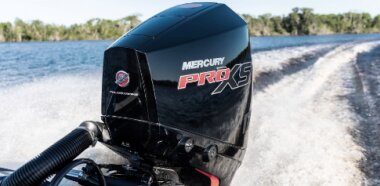
Suzuki DF30A Specifications
| Engine Model: Suzuki DF30A |
| Engine Type: 4-stroke 3-cylinder SOHC gasoline outboard engine |
| Total Displacement: 29.9 cu.in (490 cc) |
| Rated Engine Power: 30 Hp (22.1 kW) at 6300 rpm |
| Fuel System: Electronic fuel injection |
____________________________________________________________________________________
The Suzuki DF30A is a four-stroke,
three-cylinder outboard engine featuring a Single Overhead Camshaft
(SOHC) design. The engine displacement measures 29.9 cubic inches or 490
cc, achieved through a cylinder bore of 2.38 inches (60.4 mm) and a
piston stroke of 2.24 inches (57.0 mm). The powerhead produces a maximum
output of 30.0 Hp, equivalent to 22.1 kW.
The engine is designed to operate within a wide-open throttle range of
5300 to 6300 rpm, maintaining a stable idle speed of 850 rpm, plus or
minus 50. The compression ratio is specified at 10.0:1. Lubrication is
managed by a trochoid pump operating within a wet sump configuration.
The engine utilizes a water-cooled system and expels exhaust through the
propeller hub.
Ignition is handled by a digital Capacitor Discharge Ignition (CDI)
system. Starting is facilitated by either a recoil starter or an
electric starter, complemented by a manual or electric choke system. The
electrical system operates on a 12-volt basis, with charging provided by
a 14-amp alternator.
The foundation of the DF30A engine is its cylinder block, machined to
precise tolerances. The cylinder bore inside diameter is specified at
2.3780 to 2.3785 inches, or 60.400 to 60.415 mm, with a maximum
allowable out-of-round measurement of 0.002 inch (0.050 mm). The
rotating assembly is built around a crankshaft with a maximum runout
limit of 0.0016 inch (0.040 mm).
Crankshaft journal outside diameter measures 1.2594 to 1.2598 inches
(31.986 to 32.000 mm), maintaining an oil clearance of 0.0008 to 0.0020
inch (0.020 to 0.051 mm). Crank pin outside diameter is 1.1413
to 1.1417 inches (28.989 to 29.000 mm) with a width of 0.7913 to 0.7953
inch (20.100 to 20.200 mm). Connecting rods feature a big end inside
diameter of 1.1427 to 1.1431 inches (29.025 to 29.034 mm), resulting in
an oil clearance of 0.0010 to 0.0019 inch (0.025 to 0.049 mm).
The connecting rod side clearance at the big end is 0.0039 to 0.0098
inch (0.100 to 0.250 mm), with a rod width of 0.7854 to 0.7874
inch (19.950 to 20.000 mm). The small end inside diameter measures
0.6302 to 0.6304 inch (16.006 to 16.014 mm). Pistons are manufactured
with a skirt diameter of 2.3766 to 2.3772 inches (60.365 to 60.380 mm),
establishing a piston-to-cylinder clearance of 0.0011 to 0.0017 inch
(0.0271 to 0.0425 mm).
The piston pin outside diameter is 0.6297 to 0.6299 inch (15.995 to
16.000 mm), fitting into a piston pin bore of 0.6300 to 0.6302 inch
(16.002 to 16.008 mm) with a clearance of 0.0001 to 0.0005 inch (0.002
to 0.013 mm). The piston ring set includes a top ring with a
width of 0.040 to 0.041 inch (1.02 to 1.04 mm) and an end gap of 0.0047
to 0.0098 inch (0.12 to 0.25 mm).
The second ring measures 0.048 to 0.049 inch (1.21 to 1.23 mm) in width
with an end gap of 0.0102 to 0.0154 inch (0.26 to 0.39 millimeter). The
oil ring width is 0.079 to 0.080 inch (2.01 to 2.03 mm). Side clearance
for the top ring is 0.0012 to 0.0028 inch (0.030 to 0.070 mm),
while the second ring operates with a side clearance of 0.0008 to 0.0024
inch (0.02 to 0.06 mm).
The cylinder head assembly incorporates the valvetrain and must remain
within a warp limit of 0.002 inch (0.050 mm). The intake valves
feature a head diameter of 1.14 inches (29.0 mm) with a minimum head
thickness of 0.02 inch (0.50 mm). Exhaust valves have a head
diameter of 1.02 inches (26.0 mm) with an identical head thickness
specification.
Intake valve stem outside diameter measures 0.1959 to 0.1965 inch (4.975
to 4.990 mm), while exhaust valve stems are slightly smaller at 0.1950
to 0.1957 inch (4.955 to 4.970 mm). Both intake and exhaust valve guides
share an inside diameter of 0.1969 to 0.1973 inch (5.000 to 5.012 mm).
This results in a stem-to-guide clearance of 0.0004 to 0.0015 inch
(0.010 to 0.037 mm) for intake valves and 0.0012 to 0.0022 inch
(0.030 to 0.057 mm) for exhaust valves.
Valve seat width is consistent for both intake and exhaust at 0.035 to
0.043 inch (0.9 to 1.1 mm). The valve springs have a free length of 1.35
inches (34.29 mm). Camshaft profiles are ground to specific heights,
with intake lobes measuring 1.0012 to 1.0035 inches (25.430 to 25.490
mm) and exhaust lobes measuring 0.9898 to 0.9921 inch (25.140 to 25.200
mm).
Camshaft journal outside diameters are specified at 1.0614 to 1.0622
inches (26.959 to 26.980 mm) for the upper journal, 1.3563 to 1.3573
inches (34.450 to 34.475 mm) for the center journal, and 0.9039 to
0.9047 inch (22.959 to 22.980 mm) for the lower journal. The oil
clearance for these journals ranges from 0.0008 to 0.0024 inch (0.020 to
0.062 mm).
The DF30A employs an electronic fuel injection system that operates
without the need for a battery, utilizing components redesigned from
larger outboards to fit the compact powerhead. This system integrates
with Suzuki's Lean Burn Control technology, which continuously monitors
operating conditions to deliver the optimal air-fuel mixture for
combustion efficiency.
The integral fuel pump draws from a standard 6.6-gallon or 25-liter
remote fuel tank. The engine is designed to run on unleaded gasoline
with a minimum octane rating of 87, although 91 octane fuel is also
acceptable for optimal performance.
Engine lubrication is maintained through a wet sump system pressurized
by a trochoid-type oil pump. The system requires 1.58 US quarts or 1.50
liters of engine oil meeting API service classifications SG, SH, SJ, SL,
or SM.
Recommended viscosity grades include SAE 10W-30 and 10W-40 for normal
operating conditions. Routine oil changes are essential for engine
longevity, with the oil filter requiring replacement at specified
intervals.
Cooling is accomplished through a positive displacement water pump that
draws water from the lower unit. The system incorporates a thermostat to
regulate engine operating temperature, ensuring efficient combustion and
durability.
A freshwater flushing attachment is integrated into the design, allowing
easy connection of a garden hose for rinsing the cooling passages after
operation in salt or brackish water, which simplifies maintenance
procedures.
| Mid Section and Lower Unit |
The mid section houses the driveshaft and provides the structural
connection between the powerhead and the lower unit. The exhaust system
is designed to route gases through the propeller hub for quieter
operation.
The lower unit contains the bevel gear reduction system with a ratio of
2.09:1, representing one of the largest reduction gear ratios in its
class. This high ratio contributes to powerful torque for rapid
acceleration and strong pulling capability. The gearcase holds 0.35 US
quart or 0.33 liter of gear lubricant, which must meet GL5 SAE 90
specifications. The gear shift mechanism provides forward, neutral, and
reverse functions.
The DF30A series offers multiple trim and tilt configurations to
accommodate different boating requirements. Base models feature a manual
trim and tilt system with five tilt pin positions. The DF30AQ and
DF30AQE variants incorporate a gas-assisted manual system that reduces
the physical effort required for tilting.
The DF30AT and DF30ATH models feature power trim and tilt, operated by a
handlebar or remote switch for effortless adjustment. The trim angle
range extends from zero to sixteen degrees, while maximum tilt angle
reaches sixty-nine degrees. A tilt lock lever is provided to support the
motor in the fully raised position when the boat is stationary,
relieving pressure on the hydraulic system.
The DF30A is equipped with a three-bladed aluminum propeller as standard
equipment. The propeller diameter measures 10.25 inches or 260 mm. A
range of pitch options allows fine-tuning for specific applications,
including 9, 10, 11, 12, 13, 14, and 15 inches, corresponding to 228,
254, 280, 304, 330, 355, and 381 mm respectively. Propeller selection
depends on boat type, load, and intended use to achieve optimal engine
performance within the recommended full-throttle operating range.
The DF30A is offered in both short and long shaft configurations.
Overall width measures 15.5 inches or 395.0 mm. The short shaft version
has an overall height of 48.4 inches (1230.0 mm) with a transom height
of 15 inches (381 mm). The long shaft version stands 53.4 inches (1355.0
mm) tall with a 20-inch (508-millimeter) transom height.
Overall length varies by model, measuring 27.4 inches (695.0 mm) for
standard configurations, with the DF30AR at 25.4 inches (645.0 mm) and
the DF30AT at 26.5 inches (673.0 mm). Weight varies significantly based
on equipment level. The base DF30A model weighs 139.0 lbs (63.0 kg) in
short shaft and 141.0 lbs (64.0 kg) in long shaft. The DF30AE electric
start models weigh 145.0 lbs (66.0 kg) and 148.0 lbs (67.0 kg)
respectively.
The DF30AR manual tiller models weigh 141.0 lbs (64.0 kg) short shaft
and 145.0 lbs (66.0 kg) long shaft. Remote steer models with power trim
and tilt are heavier, with the DF30ATH reaching 163.0 lbs (74.0 kg)
short shaft and 165.0 lbs (75.0 kg) long shaft. These weights position
the DF30A as one of the lightest outboards in the thirty Hp category.
Routine maintenance ensures reliable operation and longevity for the
DF30A. Engine oil capacity is 1.58 US quarts or 1.50 liters. Gearcase
capacity is 0.35 US quart or 0.33 liter. Ignition timing is set at 7 to
25 degrees Before Top Dead Center. The specified spark plug is NGK
CPR6EA-9, with a gap setting of 0.031 to 0.035 inch, or 0.8 to 0.9
millimeter.
Valve lash adjustment requires intake valve clearance of 0.007 to 0.009
inch (0.18 to 0.22 millimeter) and exhaust valve clearance of 0.008 to
0.009 inch (0.20 to 0.24 millimeter). A comprehensive maintenance
schedule guides service intervals. Every 100 hours of operation,
inspections should include battery condition, spark plug, breather and
fuel line integrity, low pressure fuel filter, anodes, thermostat
function, and propeller nut and pin security, along with engine and gear
oil changes.
At 200-hour intervals, tasks expand to include replacement of the oil
filter, checking valve lash, inspecting the timing belt and water pump,
verifying idle speed, and examining the air cleaner element. Spark plug
replacement and water pump impeller replacement occur every 300 hours.
The fuel filter should be replaced every 400 hours, with low pressure
pump filter checks at 1000-hour intervals.
Precise fastener torque is critical for proper engine assembly and
operation. Critical torque specifications include the cylinder head
bolts at 30 Nm or 21.7 lb-ft. Crankcase bolts inside the assembly
require 28 Nm (21.0 lb-ft), while outside crankcase bolts are torqued to
11 Nm (8.0 lb-ft). Connecting rod cap bolts are tightened to 10 Nm (7.2
lb-ft).
The flywheel nut demands 100 Nm (75.5 lb-ft). Camshaft pulley bolts
receive 30 Nm (22.0 lb-ft) and crankshaft timing pulley nuts 50 Nm (36.0
lb-ft). Rocker arm shaft bolts are set at 6 Nm (4.4 lb-ft) with valve
adjusting screw lock nuts at 10 Nm (8.0 lb-ft). Intake manifold bolts
and nuts require 23 Nm (16.5 lb-ft).
The oil pressure regulator tightens to 27 Nm (19.5 lb-ft). Throttle body
and low pressure fuel pump bolts are both set at 11 Nm (8.0 lb-ft).
Starter motor mounting bolts take 23 Nm (16.5 lb-ft). Oil pump bolts are
torqued to 11 Nm (8.0 lb-ft). The engine oil filter requires 14 Nm (10.5
lb-ft).
Water pump case nuts are tightened to 6 Nm (4.3 lb-ft). Power unit
mounting bolts, driveshaft housing bolts, gearcase bolts, and tiller
handle bolts all share a specification of 23 Nm (16.5 lb-ft). The
propeller nut is torqued to 25 Nm (18.0 lb-ft). Spark plugs are
installed at 10 to 12 Nm or 7.5 to 9.0 lb-ft.
The versatility of the DF30A makes it suitable for a wide range of
watercraft. Its compact dimensions and light weight benefit smaller
vessels such as tenders, rigid inflatable boats, and dinghies where
portability and storage are considerations. The power output and torque
characteristics suit larger fishing boats, console boats, and sport
boats up to approximately six meters in length.
For heavier applications such as fully equipped fishing boats or light
commercial workboats, the DF30A provides reliable propulsion. Sailboat
owners utilize long shaft versions as auxiliary power for yachts. The
availability of tiller and remote steering configurations, along with
multiple trim and tilt options, allows the engine to be matched
precisely to the boat and operator preference.
____________________________________________________________________________________
| Outboard Engines Technical Specifications |
| Small Engines Technical Specifications |
| Car Engines Technical Specifications |
| Industrial Engines Technical Specifications |