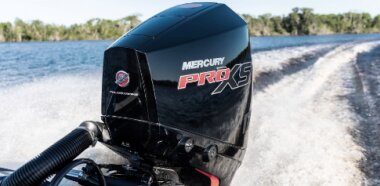
Mercury 9.9 ELHPT Specifications
| Engine Model: Mercury 9.9ELHPT |
| Engine Type: 4-stroke 2-cylinder SOHC gasoline outboard engine |
| Total Displacement: 12.8 cu.in (209 cc) |
| Rated Engine Power: 9.9 Hp (7.3 kW) at 6200 rpm |
| Fuel System: Electronic fuel fnjection (EFI) |
____________________________________________________________________________________
The Mercury 9.9ELHPT ProKicker is a
purpose-built trolling and auxiliary outboard that prioritizes low-speed
control, rugged durability, and operator convenience. Its defining
characteristic is the Command Thrust (CT) gearcase, which features a
deeper housing and a custom-matched, four-blade high-thrust propeller.
This design places the propeller deeper, below turbulent water, to
deliver superior thrust and precise control, enabling anglers to dial in
accurate bait presentations even in tough fishing conditions.
The powerhead is a smooth and quiet inline two-cylinder four-stroke with
Electronic Fuel Injection (EFI) on modern models, ensuring instant
starting and controlled throttle response in all weather. The innovative
tiller handle is ambidextrous, with a reversible throttle grip for left
or right-hand control and lateral/vertical adjustments for a comfortable
steering angle.
The engine incorporates an operator warning system for low oil pressure
and over-rev conditions, and its design emphasizes easy maintenance with
features like a no-spill oil-change system and a maintenance-free valve
train.
The Mercury 9.9 ELHPT is defined by precise engineering parameters that
optimize its performance for trolling and auxiliary applications. Note
that specifications can vary between model years, particularly regarding
fuel system and gear ratio.
Maximum Power Output: 9.9 Hp (7.3 kW) at the propeller shaft.
Full Throttle Operating Range: 5000 to 6000 RPM for many models.
Some newer EFI models may have a range of 5700 to 6200 RPM.
Engine Type: Inline 2-cylinder, four-stroke with Single Overhead
Camshaft (SOHC) and two valves per cylinder.
Displacement: 208 cc (12.8 cubic inches).
Bore and Stroke: 55 mm (2.16 inches) bore and 44 mm (1.73 inches)
stroke.
Fuel System: Modern models feature Electronic Fuel Injection (EFI) for
reliable starting and efficient performance.
Some models, particularly older ones, may be carbureted.
Ignition System: Capacitor Discharge Ignition (CDI) with electronic
spark advance.
Alternator Output: 6 A (76 W) on many models, providing charging output
for battery maintenance.
Some newer configurations may feature a 12-amp (145-watt) alternator.
Starting System: Electric start with a manual recoil backup.
Steering: Tiller handle (denoted by the "H" in ELHPT).The handle offers
one-handed operation of shifting, throttle, throttle friction, and tilt,
and is designed for ambidextrous use. Engine Protection: Operator
warning system for low oil pressure and over-rev, which can limit engine
speed to prevent damage.
Compatible Fuel: Unleaded regular gasoline with a minimum octane rating
of 87, containing up to 10 percent ethanol. Recommended Oil: Mercury
FourStroke Oil 10W-30 or 25W-40 Synthetic Blend.
The foundation of the Mercury 9.9ELHPT is a compact and robust inline
two-cylinder block designed for smooth operation and long-term
durability. Configuration: Inline 2-cylinder. Displacement: 208 cc (12.8
cubic inches). Bore and Stroke: The cylinder bore is 55 mm (2.16 inches)
and the piston stroke is 44 mm (1.73 inches).
Engine Type: Four-stroke, providing clean operation, exceptional fuel
efficiency, and quiet running. The powerhead is balanced and mounted
with soft-rubber mounts to isolate vibration, enhancing comfort during
long hours of trolling.
The cylinder head assembly is designed for efficient gas exchange and
maintenance-free operation, contributing to the engine's reliability and
low-speed tractability. Valvetrain Design: Single Overhead Camshaft
(SOHC) configuration with two valves per cylinder.
Valves per Cylinder: Two, resulting in a total of four valves for the
engine. Valve Train Maintenance: The valve train features a lifetime
maintenance-free design, eliminating the need for periodic valve
adjustments.
The fuel system on modern Mercury 9.9 ELHPT models utilizes advanced
electronic controls to provide enhanced reliability and precise fuel
delivery at trolling speeds. Induction System: Electronic Fuel Injection
(EFI) provides precise fuel metering for effortless starting, controlled
throttle response, and superior fuel efficiency.
Fuel Delivery: An electric fuel pump delivers fuel from the remote tank
to the injector at the required pressure. The engine is typically sold
with a standard 12-liter (3.2-gallon) remote fuel tank. Recommended
Fuel: Minimum 87-octane unleaded petrol is specified to ensure proper
combustion.
The four-stroke design incorporates a self-contained, high-pressure
wet-sump lubrication system ensuring all moving parts are properly oiled
for long-term durability. System Type: Wet sump, with engine oil stored
in a sump within the oil pan.
Oil Capacity: The engine oil capacity is 0.8 liters (27.0 fluid ounces).
Oil Filling and Change: The engine features a convenient no-spill
oil-change system for cleaner and easier maintenance.
Recommended Oil: Mercury FourStroke Oil 10W-30 or 25W-40 Synthetic Blend
is specified for optimal protection and performance. Low Oil Pressure
Warning: A warning system alerts the operator if engine oil pressure is
low, which can limit engine speed to prevent damage.
To manage engine temperature, the Mercury 9.9ELHPT uses a positive
displacement water pump for raw water cooling. System Type: Water-cooled
with a thermostat, drawing outside water through an intake in the
gearcase to cool the engine.
Core Components: A rubber-impeller water pump, driven by the driveshaft,
pulls water from the lake or ocean. A thermostat regulates the flow to
maintain the engine at its optimal operating temperature. Flushing
System: A quick-connect flush system is provided for easy flushing of
the cooling system with a garden hose after operation in salt or
polluted water.
| Mid Section and Lower Unit |
The mid-section houses the exhaust and driveshaft, while the lower unit
is specifically engineered for high-thrust trolling applications,
defining the ProKicker's specialized performance. Gearcase Design: The
ProKicker features the Command Thrust (CT) gearcase, a deeper design
with larger, more robust components to handle higher thrust loads. This
places the propeller deeper for better grip in turbulent water.
Gear Ratio: The gear ratio varies by model year. Many Command Thrust
models have a ratio of 2.42:1. Some models, including certain "Bigfoot"
variants, are listed with a ratio of 2.08:1. Gear Shift: Standard
forward-neutral-reverse (F-N-R) shifting operation.
Exhaust: Through-propeller exhaust release for quieter operation. Skeg:
A heavy-duty skeg provides additional protection for the propeller and
gearcase in shallow water. Gearcase Lubrication: The gearcase holds
dedicated high-grade marine gear lubricant, with an easy-change system
for convenient maintenance.
The engine is equipped with a power tilt system for effortless
adjustment of the engine's angle relative to the transom, with
additional manual trim adjustments. System Type: Power Tilt, standard on
EFI-equipped ProKicker models. The power tilt deploys the engine quickly
and effortlessly.
Tilt Function: The power tilt switch, located on the tiller handle,
lifts the engine out of the water for trailering, launching, beaching,
or shallow water anchoring. Trim Adjustment: Models feature ratcheting
trim positions, allowing the operator to preset the engine angle for
optimal performance. The shallow water trim range is 16 deg.
Kicker Strap: Centering straps (kicker straps) on tiller models
automatically straighten and lock the outboard when tilted fully up,
preventing the engine from turning while trailering or when running on
plane with the main outboard.
Propeller Design: The ProKicker utilizes a custom-matched, four-blade
high-thrust propeller specifically designed for refined trolling speed
authority. This propeller design delivers superior thrust and precise
control at low speeds.
Propeller Size: The four-blade propeller is larger in diameter than
those used on standard 9.9hp gearcases, though a specific diameter and
pitch are not listed in the provided search results.
Shaft Length is available in two primary
configurations:
Long shaft: 508 mm (20 inches), designed for boats with a standard
transom height.
Extra-long shaft: 635 mm (25 inches), designed for boats with higher
transoms.
Dry Weight: The weight varies by model year and shaft length. The
lightest long-shaft models are listed at approximately 44 kg (96 lbs).
Some newer models with EFI are listed at 55 kg (122 lbs).
Routine Maintenance (Every 100 Hours /
Annually):
Change the engine oil using the no-spill system.
Replace the gearcase lubricant using the easy-change system.
Inspect and clean or replace the spark plugs.
Check and clean the fuel filter.
Inspect the fuel system for leaks or deterioration.
Check and clean the anti-corrosion anodes, replacing them if more than
50 percent eroded.
Lubricate all moving parts and pivot points.
Check the tightness of bolts, nuts, and other fasteners.
Inspect the battery condition and electrolyte levels.
Critical Maintenance Items:
Water Pump Impeller: Should be replaced periodically as preventative
maintenance to prevent overheating due to impeller failure. The
quick-connect flush system facilitates cooling system care.
Valve Clearance: The SOHC valvetrain is designed to be maintenance-free,
requiring no periodic valve adjustments.
Corrosion Protection: Regularly inspect sacrificial anodes and replace
when deteriorated.
Flushing: Flush the cooling system with fresh water after each use in
saltwater or polluted water using the quick-connect flush system.
Periodic Checks:
Propeller condition for dings, cracks, or fishing line.
Engine mounting hardware for correct torque.
Operation of the power tilt system.
Warning system operation by observing the low oil pressure indicator.
Spark Plugs: Torque to specifications listed in the operator's manual or
service manual.
Propeller Nut: 40 Nm (30 lb-ft).
Gearcase Mounting Nuts: 40 Nm (30 lb-ft).
Engine Mounting Bolts (to transom): 55-60 Nm (41-44 lb-ft).
Fishing Boats: The engine is specifically designed as a dedicated
trolling motor for walleye rigs, bass boats, multi-species boats, and
aluminum fishing boats, providing accurate speed control for bait
presentation in tough conditions. Auxiliary Power: It functions as a
dependable secondary engine for larger vessels, providing redundancy and
improved low-speed handling and maneuverability in congested areas or
challenging conditions.
Pontoon Boats: The high-thrust design provides reliable slow-speed
maneuvering and trolling capability for pontoon boats. Sailboats: The
engine serves as an excellent auxiliary power source for daysailers and
cruising sailboats, offering reliable backup power and maneuvering
capability in harbors. Jon Boats and Utility Boats: Its compact size and
lightweight construction make it suitable for jon boats, inflatable soft
hull boats, and small utility craft.
____________________________________________________________________________________
| Outboard Engines Technical Specifications |
| Small Engines Technical Specifications |
| Car Engines Technical Specifications |
| Industrial Engines Technical Specifications |