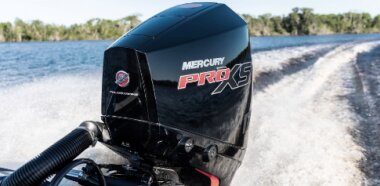
Mercury 300XS Optimax Specifications
| Engine Model: Mercury Optimax 300XS |
| Engine Type: 2-stroke 6-cylinder gasoline outboard engine |
| Total Displacement: 193 cu.in (3.2 L) |
| Rated Engine Power: 300 Hp (224 kW) at 5800 rpm |
| Fuel System: Direct Fuel Injection (DFI) |
____________________________________________________________________________________
The Mercury Optimax 300XS is a high-output
two-stroke outboard that commands respect in racing and high-performance
recreational circles. Its defining characteristic is the 3.2-liter
"Stroker" V-6 powerhead featuring a stroked and precision-balanced
crankshaft for maximum displacement and power output from the compact
60-degree V configuration. The engine incorporates exhaust port,
combustion chamber, and fuel induction designs that are direct
descendants from Mercury's Formula 1 tunnel boat race engines, including
enhanced airflow through the reed block system using thinner reed
materials and the unique reed shape developed for F1 competition.
New pistons feature an updated profile and a composite coating for
improved wear life, while piston ring life is doubled thanks to a
composite chrome coating. The fuel system operates at 95 psi injection
pressure, 15 psi higher than standard Optimax products, delivering
superior atomization and enhanced high-RPM running quality.
The Mercury Optimax 300XS is defined by its race-bred 60-degree V-6
two-stroke architecture combined with an enhanced two-stage direct fuel
injection system operating at elevated pressures. This configuration
delivers 300 Hp from a 3.2-liter displacement package.
Propshaft Rated Power: 300 HP (224 kW).
Engine Type: 60-degree V-6, 2-Stroke Direct Injection.
Displacement: 3.2 Liters (193 cubic inches / 3160 cc).
Bore and Stroke: 3.63 inches (92 mm) bore by 3.11 inches (79 mm) stroke.
Full Throttle RPM Range: 5400-5800 RPM (20-inch models 5400-6100 RPM).
Fuel Induction System: 2-Stage Direct Fuel Injection.
Fuel/Air Injection Pressure: 95 psi, 15 psi higher than standard Optimax
products for enhanced high-RPM running quality.
Ignition System: PCM Digital Inductive with 14-pin Deutsch connector
harness incorporating engine ignition and SmartCraft CAN.
Charging System: 60-amp (756 watt) belt-driven alternator with voltage
regulator.
Fuel Requirements: 91 Octane Minimum (R+M)/2 (96 RON).
Lubrication System: Electronic Multipoint.
Recommended Oil: Mercury Premium Plus (TC-W3) 2-Stroke Oil.
Rotation Options: Right or Left-Hand (Fleet Master), Right-hand (Sport
Master and Torque Master).
Shaft Length Options: 20 inches (508 mm), 25 inches (635 mm), or 30
inches (762 mm).
Gearcase Options: Fleet Master, Sport Master, or Torque Master with
various gear ratios.
Engine Management System: SmartCraft PCM 07 microprocessor.
Engine Protection System: SmartCraft Engine Guardian monitors engine
functions for early indications of problems.
Noise Reduction: Foam-lined cowl and attenuator for the compressor
greatly reduce operating decibels.
Mounting: Softer upper and lower engine mounts on 25-inch and 30-inch
models reduce through-hull noise vibration harshness.
The foundation of the Mercury 300XS Optimax is its race-developed
3.2-liter V-6 powerhead, featuring a stroked and precision-balanced
crankshaft for maximum displacement and performance. A dampener ensures
smooth running throughout the engine operating range, critical for both
reliability and driver comfort in high-speed applications. New pistons
feature an updated profile and a composite coating for improved wear
life, while piston ring life is doubled thanks to a composite chrome
coating that withstands the extreme conditions of racing operation.
The exhaust port, combustion chamber, and fuel induction designs are
direct descendants from Mercury's Formula 1 tunnel boat race engine.
Extensive research and development resulted in Formula 1 race-based
exhaust porting and reed block fuel induction design for top power.
Airflow through the reed block system is enhanced due to an improved air
box design along with thinner reed material and the unique reed shape
developed for Formula 1 racing. A new combustion chamber design results
in the engine producing peak power longer at the upper end of the
operating RPM range.
The heavy-duty direct fuel injection air compressor features robust
maxi-coated mounting brackets and hardware for enhanced compressor
durability and reliability under sustained high-RPM operation.
The heart of the Optimax 300XS is its enhanced two-stage direct fuel
injection system, which represents a significant advancement over
standard Optimax technology. A unique two-stage direct-injection system
atomizes fuel into small, uniform particles, resulting in complete and
instantaneous combustion. The fuel and air mixture is injected into the
combustion chamber at 95 psi, providing a 15 psi higher fuel/air
differential than standard DFI or Optimax products for enhanced high-RPM
running quality.
This elevated injection pressure ensures superior atomization and
combustion efficiency at the engine's maximum power output, contributing
to its 300 Hp rating while maintaining the fuel efficiency and reduced
emissions inherent to Optimax technology. The system is managed by a new
PCM 07 microprocessor featuring a 14-pin Deutsch connector harness that
incorporates engine ignition and SmartCraft CAN (controller area
network) for comprehensive monitoring and control.
The Mercury 300XS Optimax employs an electronic multipoint lubrication
system that delivers precise amounts of oil where and when it is needed.
This advanced system ensures optimal lubrication under all operating
conditions, from idle to the 6100 RPM maximum on 20-inch models. The
system draws from an 11.5-liter remote oil tank and uses Mercury Premium
Plus TC-W3 two-stroke oil or equivalent NMMA TC-W3 certified lubricants.
Ravenol recommends their Outboardoel 2T Fullsynth for Optimax DFI
systems, noting it meets NMMA TC-W3 requirements and is suitable for
engines with separate auto-lube systems. The electronic control ensures
the correct oil-to-fuel ratio across the operating range, minimizing
smoke and deposits while providing the protection required for sustained
high-performance operation.
The cooling system on the Optimax 300XS is a water-cooled design
engineered to manage the substantial thermal load generated by 300 Hp. A
high-output water pump ensures adequate flow even at idle speeds, while
the system design maintains proper pressure to prevent hot spots within
the cylinders and heads.
The engine features a tell-tale stream that provides visual confirmation
of water pump operation. After operation in salt or brackish water,
flushing the cooling system with fresh water is required to prevent salt
crystal accumulation and internal corrosion. The water pump impeller
requires periodic replacement as part of preventive maintenance to
ensure consistent cooling system performance.0
| Mid Section and Lower Unit |
The mid section houses the driveshaft and provides the structural
connection between powerhead and lower unit while containing the exhaust
system. On 25-inch and 30-inch models, through-hull noise vibration
harshness is further reduced thanks to the use of softer upper and lower
engine mounts.
The Optimax 300XS offers multiple gearcase options to suit different
performance applications. The Fleet Master gearcase is available with
1.75:1 gear ratio in either right or left-hand rotation. The Sport
Master gearcase is available with 1.62:1 or 1.75:1 ratios in right-hand
rotation. The Torque Master gearcase is available with 1.75:1 ratio in
right-hand rotation. This variety of gearcase options allows operators
to select the optimal configuration for their specific hull and
performance requirements.
Gearcase Options: Fleet Master, Sport Master, or Torque Master
Gear Ratios: 1.62:1 (Sport Master) or 1.75:1 (Fleet Master, Sport
Master, Torque Master)
Rotation: Right or Left-Hand (Fleet Master), Right-hand (Sport Master
and Torque Master)
Shaft Length Options: 20 inches (508 mm), 25 inches (635 mm), 30 inches
(762 mm)
The Optimax 300XS incorporates a heavy-duty power trim and tilt system
that provides precise control over engine angle for optimal performance
across varying conditions. The system consists of an electric motor,
hydraulic pump, fluid reservoir, and hydraulic cylinders. Operators can
adjust the outboard position using trim switches, with trimming in
improving acceleration and hole-shot performance, and trimming out
lifting the bow to increase top speed and reduce drag.
The system allows shallow water operation by tilting the engine past the
normal trim range at low idle speeds. Ravenol Marine Power Trim and
Steering Fluid is recommended for the hydraulic system, formulated for
excellent lubrication of marine hydraulics with high and stable
viscosity index and reliable corrosion protection.
Propeller selection for the Optimax 300XS is critical to achieving its
full performance potential. The correct propeller must allow the engine
to operate within its 5400-5800 RPM full throttle range (5400-6100 for
20-inch models) when the boat is normally loaded. The multiple gearcase
options (1.62:1 and 1.75:1 ratios) and rotation choices (right or
left-hand) provide exceptional flexibility for matching propeller
selection to hull design and performance requirements.
Mercury Racing propellers specifically designed for high-performance
applications feature advanced blade geometries that enhance acceleration
and top-end speed. The propeller hub incorporates a damping system to
protect the lower unit from impact damage. Propeller blades require
regular inspection for damage, and any bent or missing blades must be
addressed immediately to prevent vibration and further damage.
Weight (20-inch L model): 505 lbs (229 kg)
Weight (25-inch XL model): 517 lbs (235 kg)
Weight (30-inch XXL model): 534 lbs (242 kg)
Shaft Length Options: 20 inches (508 mm), 25 inches (635 mm), 30 inches
(762 mm)
Recommended Oil: Mercury Premium Plus (TC-W3) 2-Stroke Oil or equivalent
NMMA TC-W3 certified oil. Remote Oil Tank Capacity: 11.5 liters. Cooling
System Flushing: After operation in salt or polluted water, flushing is
required to remove salt and debris preventing overheating and internal
corrosion.
Power Package Care: Periodic inspections and maintenance must be
performed according to the Inspection and Maintenance Schedule. Mercury
recommends having maintenance performed by an authorized Mercury Marine
dealer if unfamiliar with proper procedures.
Submerged Power Package: A submerged power package requires prompt
service by an authorized dealer after recovery. This immediate attention
is necessary once the engine is exposed to the atmosphere to minimize
internal corrosion damage to the engine.
Replacement Parts: Mercury recommends using original Mercury Precision
replacement parts and lubricants to ensure safety and retain
dependability. EPA Emissions: Outboard motors sold in the United States
are certified by the EPA as conforming to air pollution regulations,
requiring factory procedures for servicing to be strictly followed.
The Mercury Optimax 300XS powers a highly specific range of
performance-oriented watercraft requiring exceptional power and
reliability. Its primary applications include the P1 SuperStock
single-engine V-bottom raceboat series, where it was selected as the
spec power for the 2017 season. Powerboat P1 USA chose the Mercury
Racing 300XS Optimax due to "their extensive record of reliability in
conditions and applications that most closely parallel our racing
series". The engine replaced Evinrude outboards in the series' raceboat
lease program, with all P1 SuperStock raceboats running Mercury Racing
300XS power.
Beyond organized racing, the Optimax 300XS is used in high-performance
bass boats, offshore fishing vessels, and other applications where 300
Hp and Mercury Racing pedigree are desired. The availability of three
shaft lengths (20, 25, and 30 inches) and multiple gearcase options
(Fleet Master, Sport Master, Torque Master) with various gear ratios and
rotation directions allows the engine to be configured for virtually any
high-performance application.
____________________________________________________________________________________
| Outboard Engines Technical Specifications |
| Small Engines Technical Specifications |
| Car Engines Technical Specifications |
| Industrial Engines Technical Specifications |