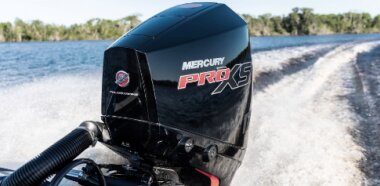
Mercury 250 Verado Specifications
| Engine Model: Mercury Verado 250 V8 |
| Engine Type: 4-stroke 8-cylinder DOHC 32-valve gasoline outboard engine |
| Total Displacement: 279 cu.in (4.6 L) |
| Rated Engine Power: 250 Hp (186 kW) at 6000 rpm |
| Fuel System: Electronic Fuel Injection (EFI) |
____________________________________________________________________________________
The Mercury Verado 250 V8 is a four-stroke
outboard that prioritizes a premium boating experience. Its foundation
is a substantial 4.6-liter V8 powerhead, which provides ample torque for
impressive acceleration and the ability to effortlessly push heavy boats
onto plane. The engine's character is defined by its exceptionally quiet
and vibration-free operation, a direct result of the innovative Advanced
MidSection (AMS) that isolates the powerhead from the transom.
This, combined with features like Adaptive Speed Control (ASC) that
maintains a set engine speed regardless of changing water conditions,
reduces operator fatigue and enhances comfort. Integrated with Mercury's
SmartCraft digital technology, including Digital Throttle and Shift
(DTS) and electro-hydraulic power steering, the Verado 250 offers
precise, instantaneous control, making it a top contender for a wide
range of boat applications, from offshore fishing vessels to performance
cruisers.
Engine Type: V8 with a 64-degree bank angle.
Displacement: 4.6 Liters (279 cubic inches).
Power Output: 250 Hp at the propeller shaft (186 kW).
Full Throttle Operating Range: 5200-6000 RPM.
Valvetrain: Dual Overhead Camshafts (DOHC) with four valves per
cylinder, totaling 32 valves.
Fuel Induction System: Computer-controlled Electronic Fuel Injection
(EFI) with Advanced Range Optimization (ARO) for improved fuel
efficiency at cruising speeds.
Ignition System: SmartCraft PCM 112 Digital Inductive ignition.
Alternator Output: A high-output 115-amp alternator generates 1449 W.
The Idle Charge feature boosts alternator output at low RPM to keep
batteries charged when running electronics.
Recommended Fuel: Unleaded regular gasoline with a minimum octane rating
of 87 (R+M/2 method) or 90 RON.
The fuel system is designed to handle up to 10% ethanol.
Engine Management and Protection: The SmartCraft Engine Guardian system
monitors critical sensors and can automatically reduce power to prevent
damage in adverse conditions.
Emissions Compliance: Certified with a CARB 3-star rating.
The foundation of the Verado 250's robust performance is its
large-displacement V8 architecture.
Cylinder Block: The engine is built around a 4.6-liter V8 block, a
design that prioritizes displacement and torque over high-strung,
smaller-displacement alternatives. This provides a broad, powerful
torque curve beneficial for all types of boating. The bore and stroke
measure 3.6 inches by 3.4 inches (92 mm by 86 mm).
Cylinder Heads and Valvetrain: Each cylinder head is configured with
Dual Overhead Camshafts (DOHC) operating four valves per cylinder (32
valves total). This DOHC, 4-valve design optimizes airflow into and out
of the combustion chambers at high RPMs, contributing to the engine's
power output and overall efficiency.
The fuel system is engineered for both performance and efficiency. It
utilizes an Electronic Fuel Injection (EFI) system, managed by the
engine's computer, to deliver precise amounts of fuel to each cylinder
for optimal combustion under all conditions.
A key feature is Advanced Range Optimization (ARO), a proprietary system
that seamlessly adjusts the fuel mixture during cruise speeds to
maximize fuel economy without any noticeable change in engine feel for
the operator. The air induction is managed by a performance-tuned,
long-runner intake manifold designed to enhance torque across the RPM
range.
The engine utilizes a reliable, integrated wet sump lubrication system.
The total oil capacity is 7.0 US quarts (6.6 liters). Mercury recommends
using NMMA-certified FCW 10W-30 oil for general use, though 25W-40 is
also specified as an option, with 10W-30 recommended for colder
operating conditions. Routine maintenance is simplified by a convenient
top cowl service door, allowing for easy oil level checks and top-ups
without removing the engine cover.
Cooling is managed by a reliable water-cooled system that draws in
ambient water. A thermostat regulates the engine's operating temperature
for optimal performance and longevity. Exhaust gases are expelled
through the propeller hub, contributing to the engine's quiet operation.
| Mid Section and Lower Unit |
Advanced MidSection (AMS): This is a defining feature of the Verado
line. The AMS is a sophisticated mounting system that cradles the
powerhead, moving the engine mounts outward and aft. This design
isolates the powerhead from the transom, resulting in a drastic
reduction in vibration - up to 66% less at the helm compared to some
competitors - and minimizing noise transmitted to the boat's hull.
Gearcase and Ratio: The engine is mated to a durable gearcase with a
primary gear ratio of 1.85:1, providing a balance of strong low-end
torque for planing and efficient cruising. The gearcase size is 5.44
inches and features a forward-neutral-reverse (F-N-R) shift. Exhaust:
The exhaust system is routed through the propeller, which further
contributes to noise reduction underwater and at the transom.
The Mercury 250 Verado is equipped with a robust electro-hydraulic power
trim and tilt system. This system allows the operator to precisely
adjust the engine angle relative to the transom for optimal boat
performance, handling, and shallow water operation.
Maximum Trim Range: 20 deg (ranging from -6 deg to +14 deg). Maximum
Tilt Range: 73 deg (ranging from -6 deg to +67 deg) for complete
trailering clearance and beaching.
Propeller selection is critical for matching the engine to the specific
boat and its intended use. Mercury offers a wide range of propellers for
the Verado 250, allowing for fine-tuning of performance. The engine is
designed to turn a propeller that allows it to operate within its
5200-6000 RPM full-throttle range at wide-open throttle.
The specific pitch and diameter will vary based on boat weight, hull
design, and application. Mercury dealers and resources like the Mercury
Propeller Selector guide are used to determine the optimal propeller for
a given setup.
Shaft Length Options:
20-inch (508 mm) - suitable for transoms with a standard height.
25-inch (635 mm) - suitable for transoms with an extra-long height.
30-inch (762 mm) - suitable for transoms with a double-extra-long
height.
Dry Weight (Lightest Model): 595-600 lbs (270-272 kg).
Every 100 hours:
Change engine oil and replace the oil filter.
Check the outboard for tightness to the boat transom.
Inspect thermostat visually for corrosion and/or for a broken spring.
Check engine water separating fuel filter for contaminants.
Clean and/or replace filter.
Drain and replace gearcase lubricant.
Check power steering fluid.
Inspect battery.
Check wiring and connectors.
Every 300 hours:
Replace water pump impeller.
Check power trim fluid.
Replace high‑pressure in‑line fuel filter.
Replace spark plugs.
Replace accessory drive belt.
Propeller Shaft Nut: 50-80 lb-ft (68-108 Nm).
Lower Unit / Gearcase Bolts: 10-25 lb-ft (13-34 Nm).
Flywheel Bolts: 35-50 lb-ft (47-68 Nm).
Cylinder Head Bolts: 15-25 lb-ft (20-34 Nm).
Connecting Rod Bolts: 11 lb-ft (15 Nm).
The versatility of the Mercury Verado 250 V8 makes it suitable for a
vast array of boat types. Its power-to-weight ratio, smooth operation,
and digital integration capabilities make it an ideal choice for both
single and multi-engine setups. Offshore Fishing Boats: Provides the
torque and reliability needed for running to distant grounds and the
smooth trolling characteristics desired by anglers. Its quiet operation
is a significant advantage for fishability.
Center Consoles and Dual Consoles: A perfect match for these popular
family and sportfishing boats, delivering exhilarating performance and
quiet cruising. Runabouts and Cuddy Cabins: Offers the refined power and
quiet operation expected for comfortable family outings, watersports,
and weekend cruising. Pontoon and Tritoon Boats: Delivers the
substantial torque required to propel large, heavy pontoon boats
efficiently and with authority, transforming their performance.
Multi-Engine Installations: Commonly used in twin, triple, or quadruple
configurations on larger offshore vessels, cruisers, and
high-performance boats. These setups benefit from the Verado's joystick
piloting compatibility, which allows for intuitive maneuvering and
station-holding capabilities. Rigid Inflatable Hulls (RIBs): Its power
and relatively light weight are well-suited for high-performance RIBs
used for diving, rescue, or recreation.
____________________________________________________________________________________
| Outboard Engines Technical Specifications |
| Small Engines Technical Specifications |
| Car Engines Technical Specifications |
| Industrial Engines Technical Specifications |