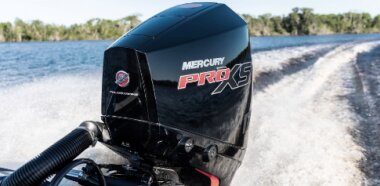
Mercury 250 Optimax Specifications
| Engine Model: Mercury Optimax 250 |
| Engine Type: 2-stroke 6-cylinder gasoline outboard engine |
| Total Displacement: 185 cu.in (3 L) |
| Rated Engine Power: 250 Hp (186 kW) at 6000 rpm |
| Fuel System: Direct Fuel Injection (DFI) |
____________________________________________________________________________________
The Mercury Optimax 250 is a direct fuel
injection two-stroke outboard that commands respect in the
high-performance marine market. Its defining characteristic is the
two-stage direct fuel injection system that atomizes fuel with
compressed air directly into the combustion chambers, enabling this
3.0-liter V-6 to produce exceptional power with remarkable efficiency.
Operators praise its instant throttle response, robust low-end torque
for rapid planing, and impressive top-end speed capabilities. The engine
incorporates SmartCraft digital technology, providing comprehensive
monitoring of engine functions and diagnostics.
While the two-stroke architecture delivers a compelling power-to-weight
ratio significantly better than equivalent four-strokes, owners must
remain vigilant about fuel system maintenance and use of proper
Mercury-specified oil to prevent issues. The Optimax 250 has proven
itself as a durable and reliable powerplant for demanding applications
ranging from bass boats to offshore center consoles when properly
maintained.
The Mercury 250 Optimax is defined by its advanced 60-degree V-6
architecture combined with the Orbital direct fuel injection system.
This configuration delivers class-leading power from a compact and
lightweight package.
Engine Type: 60-degree V-6, 2-Stroke Direct Injection
Power: 250 HP (186 kW) at the propshaft
Displacement: 3.0 Liters (185 cubic inches / 3032 cc)
Bore and Stroke: 3.63 inches (92 mm) bore by 3.00 inches (76 mm) stroke
Full Throttle RPM Range: 5500-6000 RPM
Fuel Induction System: Two-stage Direct Fuel Injection (DFI) with air
compressor
Ignition System: Digital inductive CDI with electronic spark advance
Alternator Output: 60-amp (756-watt) belt-driven, voltage-regulated
Starting System: Electric (turn-key) with remote control
Gear Ratio / Shift: 1.75:1 with forward-neutral-reverse
Lubrication: Variable-rate oil injection with 11.5-liter (3-gallon)
remote oil tank
Shaft Length Options: 20-inch or 25-inch models
Cooling System: Water-cooled with thermostat and pressure-controlled
poppet valve
Recommended Fuel: Unleaded gasoline with 87 octane (R+M)/2 minimum
(USA/Canada) or 90 RON minimum (outside USA/Canada)
Recommended Oil: Mercury OptiMax/DFI or Quicksilver DFI 2-Cycle Engine
Oil
Emissions Rating: EPA and CARB emissions certified
The foundation of the Optimax 250 is its 60-degree V-6 powerhead, an
advanced casting engineered to withstand the unique demands of direct
injection operation. The 60-degree configuration provides inherent
balance and a compact profile that reduces overall engine width compared
to traditional 90-degree V designs. The cylinders incorporate
loop-charging technology with specially designed combustion chambers
that work in concert with the direct fuel injection system.
The cylinder heads contain the components necessary for the two-stage
injection process and house the spark plugs. The powerhead shares design
elements with the entire Optimax V-6 family, ensuring robust
construction and component availability. The engine incorporates
high-strength, corrosion-resistant materials throughout the casting to
ensure durability in marine environments without adding unnecessary
bulk.
The heart of the Optimax 250 is its sophisticated two-stage Direct Fuel
Injection system, a design developed in partnership with Australia's
Orbital Engine Corporation. This system represents a fundamental
departure from conventional two-stroke fuel delivery. In the first
stage, fuel is mixed with compressed air supplied by an engine-driven
air compressor mounted to the powerhead. This compressor features an air
intake filter located in the flywheel cover that must be inspected for
blockage during troubleshooting.
The second stage injects this highly atomized mixture directly into the
combustion chambers at precisely controlled intervals. The system
includes an air regulator and tracker valve that manage air pressure
distribution; diaphragms in these components must be inspected for cuts
or tears if pressure abnormalities occur. The fuel delivery system
incorporates both low-pressure electric lift pumps and a high-pressure
pump mounted in the vapor separator.
The electric pumps operate for two seconds each time the ignition is
turned to the RUN position. Normal high-pressure pump amperage draw
ranges from 6-9 amperes, while low-pressure pumps draw 1-2 amperes. A
fuel regulator controls system pressure, and debris blocking the
regulator hole can cause high fuel pressure conditions. The vapor
separator contains a drain plug for checking fuel presence during
troubleshooting. The engine incorporates a water-separating fuel filter
that requires periodic replacement.
The Mercury 250 Optimax employs a variable-rate oil injection system
that eliminates the need for pre-mixing fuel. An 11.5-liter (3-gallon)
remote oil tank supplies oil to the injection pump, which meters
lubrication according to engine speed and load. The system uses Mercury
OptiMax/DFI or Quicksilver DFI 2-Cycle Engine Oil specifically
formulated for direct injection engines.
If this specialized oil is unavailable, Mercury or Quicksilver TC-W3
Premium Plus 2-Cycle Oil may be used as a temporary substitute, though
severe engine damage may result from use of inferior oils. An
engine-mounted oil reservoir tank with a fill cap is incorporated into
the system; filling this tank is necessary only if the oil level drops
and the low oil warning system activates.
When this occurs, the operator must loosen the fill cap and run the
engine until all air vents from the reservoir and oil reaches the
overflow point, then retighten the cap. The remote oil tank caps must be
threaded on tightly, as air leaks will prevent oil flow to the engine.
To minimize carbon deposit buildup, Mercury recommends adding Quickleen
Engine Treatment additive to the fuel at each tank fill throughout the
boating season.
The cooling system on the Optimax 250 is a sophisticated water-cooled
design with multiple control points to maintain optimal temperatures
across the operating range. The system incorporates thermostats and a
pressure-controlled poppet valve that regulates water flow based on
engine speed and temperature. The air compressor has its own dedicated
water supply circuit requiring proper flow for cooling.
The engine features a tell-tale stream that provides visual confirmation
of water pump operation. After operation in salt or brackish water,
flushing the cooling system with fresh water is required to prevent salt
crystal accumulation. The system design ensures proper cooling of all
components under the high thermal loads generated by 250 Hp output.
| Mid Section and Lower Unit |
The mid section houses the driveshaft and provides the structural
connection between powerhead and lower unit while containing the tuned
exhaust system that optimizes performance. The lower unit contains the
advanced gearcase engineered for hydrodynamic efficiency, reducing drag
for better fuel economy and speed.
The gearcase incorporates a 1.75:1 gear ratio that provides an excellent
balance of acceleration and cruising efficiency for the 250 Hp output.
The lower unit contains the forward-neutral-reverse shifting mechanism
and is protected by sacrificial anodes that control galvanic corrosion
in saltwater environments. The gearcase oil requires periodic draining
and replacement as part of routine maintenance.
Gear Ratio: 1.75:1
Shift: Forward-Neutral-Reverse
Corrosion Protection: Sacrificial anodes on gear housing requiring
regular inspection
The Optimax 250 incorporates a hydraulic Power Trim and Tilt system that
provides precise control over engine angle for optimal performance
across varying conditions. The system consists of an electric motor,
pressurized fluid reservoir, pump, and hydraulic cylinders. Operators
can adjust the outboard position by pressing the trim switch, with trim
generally referring to adjustment within the first 20 deg of travel used
while operating on plane, and tilt referring to further upward
adjustment out of the water.
Trimming the outboard in (toward the transom) improves acceleration and
helps the boat achieve plane more quickly. Trimming out (away from the
transom) lifts the bow, increasing top speed and providing greater
gearcase clearance over submerged objects. The system allows shallow
water operation by tilting the engine past the normal trim range at low
idle speeds.
A slight drop in engine RPM may be noticed when engaging power trim at
slow speeds; this condition is normal and has no adverse effect on the
outboard. The trim fluid level requires periodic inspection. Operating
around the middle of the trim range provides satisfactory results for
most boats, though operators may choose to trim fully in or out to take
full advantage of the system's capability.
Propeller selection for the Optimax 250 requires matching the propeller
pitch to the boat's weight, hull design, and intended usage to ensure
the engine operates within its 5500-6000 RPM full throttle range. The
advanced gearcase design enhances hydrodynamic efficiency and reduces
drag, allowing propellers to perform optimally.
The propeller hub incorporates a damping system to protect the lower
unit from impact damage. Stainless steel propellers are commonly used
for high-performance applications to maximize durability and efficiency.
The propeller blades require regular inspection for damage.
Weight (Dry): 505 lbs (229 kg) depending on specific model configuration
Shaft Length Options: 20 inches (508 mm) or 25 inches (635 mm)
Before Each Use: Verify engine stops with emergency stop switch,
visually inspect fuel system for wear or leaks, check outboard mounting
to transom with fastener torque of 55 lb-ft (75 Nm), inspect steering
system for binding or loose components, visually check steering link rod
fastener security, and inspect propeller blades for damage.
After Each Use: Flush cooling system when operating in salt or polluted
water, rinse salt deposits and flush propeller exhaust outlet and
gearcase with fresh water after saltwater operation.
Every 100 Hours or Annually: Retorque transom mounting fasteners to 55
lb-ft (75 Nm), lubricate all grease fittings (more frequently in
saltwater), replace spark plugs after first 100 hours then inspect every
100 hours, replace fuel filter, check air compressor intake filter on
200/225 models, inspect alternator belt, inspect sacrificial anodes
(more frequently in saltwater), drain and replace gearcase oil, check
trim fluid, inspect battery, and check control cable adjustment.
Oil Tank Capacity: 11.5 liters (3 gallons) for remote oil tank. Fuel
System: Do not use pre-mixed gas and oil in this engine. The engine
automatically receives extra oil during break-in.
Transom Mounting Fasteners: 55 lb-ft (75 Nm)
10 mm Fasteners (Powerhead to Pump): 35 lb-ft (47 Nm)
Reverse Stop Screw: 120 lb-in (14 Nm)
Forward Stop Screw: 120 lb-in (14 Nm)
Ride Plate-to-Pump Screws: 75 lb-in (8.5 Nm)
Pump Cover to Pump Housing Nuts: 35 lb-ft (47 Nm)
The Mercury Optimax 250 powers a diverse range of high-performance
watercraft, from bass boats to larger recreational vessels. Its
combination of 250 Hp, light weight, and fuel efficiency makes it
particularly well-suited for performance-oriented hulls requiring rapid
acceleration and high top-end speeds. The engine excels on center
console boats for offshore fishing, where its power-to-weight ratio
contributes to improved fuel economy and range. The Optimax 250 has
proven itself in saltwater environments due to its corrosion-resistant
materials and comprehensive anode protection system.
The engine's SmartCraft compatibility provides operators with digital
monitoring of fuel flow, engine diagnostics, and other critical data for
optimal operation. The 1.75:1 gear ratio suits a wide variety of
applications from high-speed bass boats to larger multi-species fishing
platforms. The engine meets EPA and CARB emissions standards, making it
compliant in regulated markets. Whether navigating inland lakes or
challenging coastal conditions, the Optimax 250 delivers the
reliability, efficiency, and raw power that defines Mercury's
engineering philosophy.
____________________________________________________________________________________
| Outboard Engines Technical Specifications |
| Small Engines Technical Specifications |
| Car Engines Technical Specifications |
| Industrial Engines Technical Specifications |