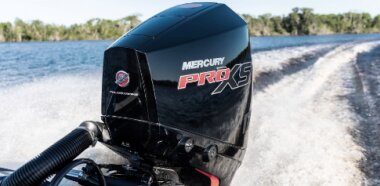
Mercury Optimax 115 Pro XS Specs
| Engine Model: Mercury Optimax Pro XS 115 |
| Engine Type: 2-stroke inline 3-cylinder gasoline outboard engine |
| Total Displacement: 91.5 cu.in (1.5 L) |
| Rated Engine Power: 115 Hp (86 kW) at 6300 rpm |
| Fuel System: Direct fuel injection (DFI) |
____________________________________________________________________________________
The Mercury Optimax Pro XS 115 is a 115-Hp,
three-cylinder inline direct fuel injection two-stroke outboard
engineered for boaters who demand high performance without compromise.
Its defining technological achievement is the two-stage Direct Fuel
Injection (DFI) system, which atomizes fuel directly into the combustion
chambers, resulting in exceptionally clean and efficient combustion.
This translates into superior fuel economy compared to conventional
carbureted two-strokes, along with dramatically reduced exhaust
emissions and smoke-free operation. The engine delivers instantaneous
throttle response and rapid acceleration characteristic of two-stroke
designs, making it ideal for applications requiring quick hole-shot
performance. The Pro XS model can be paired with the Command Thrust (CT)
gearcase, which is designed to turn a larger propeller, providing
greater acceleration, better handling, awesome maneuverability, and
superior control.
A sophisticated electronic oil injection system automatically meters oil
from an integral tank based on engine speed and load, eliminating the
need for pre-mixing fuel. The Optimax Pro XS 115 boasts the highest
displacement and lowest weight among high-output engines in its class,
for unmatched hole shot on a wide variety of boats.
Maximum Power Output: 115 Hp (86 kW) at the propeller shaft.
Full Throttle Operating Range: 5300 to 6300 RPM.
Engine Type: Three-cylinder inline, two-stroke.
Displacement: 1.5 liters (1500 cc / 91.5 cubic inches).
Bore and Stroke: 92 mm (3.63 inches) bore and 76 mm (3.00 inches)
stroke.
Fuel System: Two-stage direct fuel injection (DFI).
Ignition System: SmartCraft ECM 07 Digital Inductive system with
electronic spark advance.
Alternator Output: 60 A (756 W), providing substantial charging capacity
for sophisticated electronics and battery systems.
Starting System: Smart Start Electric, which prevents starter engagement
at high RPM.
Steering: Compatible with remote hydraulic or cable steering, as well as
tiller configurations with integrated Troll Control rpm-based speed
control.
Control Type: Remote mechanical throttle and shift.
Engine Management: Fully compatible with SmartCraft digital technology,
offering system monitoring, diagnostics, and the Engine Guardian
protection system. Compatible Fuel: Unleaded regular gasoline with a
minimum octane rating of 87 (R+M/2) or 90 RON, containing up to 10
percent ethanol. Recommended Oil: NMMA Certified FCW SAE 10W-30.
Engine Protection: SmartCraft Engine Guardian operator warning system
continuously monitors critical sensors and can reduce power to prevent
damage.
The foundation of the Mercury Optimax 115 Pro XS is a robust inline
three-cylinder block engineered to withstand the higher combustion
pressures associated with direct fuel injection while maintaining the
light weight advantageous to two-stroke designs. Configuration: Inline
3-cylinder. Displacement: 1.5 liters (1500 cc / 91.5 cubic inches). Bore
and Stroke: The cylinder bore is 92 mm (3.63 inches) and the piston
stroke is 76 mm (3.00 inches).
Cylinder Block Material: Precision-cast aluminum alloy with cast-in iron
cylinder liners for durability and wear resistance. Engine Type:
Two-stroke, which generates power with every revolution of the
crankshaft, providing characteristic acceleration and power-to-weight
advantages.
The cylinder head design for this direct injection two-stroke engine
incorporates components to support the high-pressure fuel system and
optimized combustion chambers. Configuration: Single cylinder head
covering all three cylinders.
Combustion Chamber: Optimized shape to promote efficient mixing of the
directly injected fuel charge with compressed air, ensuring complete
combustion and reduced emissions. The engine utilizes piston-controlled
intake ports and electronically controlled exhaust ports. The DFI system
replaces traditional carburetion with high-pressure fuel injectors
mounted directly in the cylinder head.
The fuel system is the defining technological achievement of the Mercury
Optimax Pro XS 115, utilizing a two-stage direct injection process that
revolutionized two-stroke efficiency.
Induction System: Two-stage direct fuel injection (DFI). This system
uses compressed air to atomize fuel and inject it directly into the
combustion chambers at high pressure. The precise metering and
ultra-fine atomization enable near-complete combustion, extracting
maximum energy from each drop of fuel while drastically reducing
unburned hydrocarbons in the exhaust.
Fuel Delivery: An electric fuel pump draws fuel from the boat tank. A
separate high-pressure system, integrated with the air compressor,
raises fuel pressure for injection. The system includes a
water-separating fuel filter with a sensor that alerts the operator if
water reaches the full level in the filter chamber.
Fuel System Maintenance: The low-pressure fuel filter should be checked
for contaminants and replaced if required according to the maintenance
schedule. Recommended Fuel: Minimum 87-octane unleaded petrol is
specified to ensure proper combustion and prevent engine knocking.
The Optimax Pro XS 115 incorporates a sophisticated oil injection system
that automatically delivers the precise amount of oil required for
lubrication based on engine operating conditions. System Type:
Electronic multipoint oil injection with a dedicated oil pump, drawing
from an integral oil tank. Oil Tank Capacity: The integral oil tank
capacity is 4.7 liters.
Oil Type: NMMA Certified FCW SAE 10W-30 is specified. Use of incorrect
oil can result in carbon buildup on injectors, poor combustion, and
severe engine damage. Oil Level Check: The engine oil level should be
checked before each use.
Oil Change Interval: Engine oil and filter should be changed every 100
hours of use or once yearly, whichever occurs first. The oil should be
changed more often when the engine is operated under adverse conditions,
such as extended trolling.
To manage engine temperature under varying loads and conditions, the
Mercury Optimax 115 Pro XS uses a positive displacement water pump for
raw water cooling, integrated with thermostatic control. System Type:
Water-cooled with thermostat, drawing outside water through an intake in
the gearcase to cool the engine block and cylinder head.
Core Components: A rubber-impeller water pump, driven by the driveshaft,
pulls water from the lake or ocean. A thermostat regulates the flow to
maintain the engine at its optimal operating temperature for efficiency
and longevity.
Flushing: The cooling system should be flushed with fresh water after
each use in salt, polluted, or muddy water. The outboard can be tilted
or in the vertical operating position during flushing. A flush connector
is provided on the engine for this purpose.
Water Pump Indicator: After starting the engine, the operator should
check for a steady stream of water flowing out of the water pump
indicator hole. If no water is coming out, the engine should be stopped
immediately and the cooling water intake checked for obstruction.
| Mid Section and Lower Unit |
The mid-section houses the exhaust and driveshaft, while the lower unit
transfers power to the propeller through a robust gearcase engineered
for high-performance applications.
Gearcase Design: The Pro XS model can be paired with the Command Thrust
(CT) gearcase, a performance-inspired design optimized for fast hole
shots, top speeds, and enhanced control at wide-open throttle. It is
designed to turn a larger propeller, providing greater acceleration,
better handling, and superior control.
Gear Ratio: 2.07:1. Gear Shift: Standard forward-neutral-reverse (F-N-R)
shifting operation. Exhaust: Through-propeller exhaust release for
quieter operation and reduced back pressure.
Gearcase Lubrication: The gearcase holds dedicated high-grade marine
gear lubricant. The lubricant should be drained and replaced every 100
hours of use or once yearly. Trim Tab: An adjustable trim tab is
provided to compensate for propeller steering torque, reducing steering
effort when the engine is trimmed for operation.
The engine is equipped with an integrated electro-hydraulic system that
allows the operator to adjust the engine's angle relative to the transom
for optimal performance and convenience. System Type: Integrated power
trim and tilt, controlled by dashboard-mounted rocker switches.
Trim Function: Allows the operator to adjust engine angle while underway
to optimize boat attitude, improve fuel efficiency, and enhance ride
quality. The maximum trim range is 22 deg, from -6 deg to +16 deg.
Tilt Function: Lifts the engine out of the water beyond the trim range
for trailering, launching, beaching, or shallow water anchoring. The
maximum tilt range is 70 deg, from -6 deg to +64 deg.
Shallow Water Operation: When operating in shallow water, the engine can
be tilted up beyond the maximum trim range, provided engine speed is
kept below 2000 RPM and all cooling water intake holes remain submerged.
On models with a three-ram trim system, if engine speed exceeds 2000
RPM, the outboard will automatically return down to the maximum trim
range.
Manual Tilt Release: A manual tilt release valve is provided to allow
manual tilting of the engine in the event of power loss or system
malfunction. Trim Fluid Check: Power trim fluid should be checked every
300 hours of use or three years.
Propeller selection is critical for matching the Mercury Optimax Pro XS
115's power characteristics to the specific boat and its intended use,
ensuring operation within the recommended full-throttle RPM range.
Propeller Design: The Command Thrust (CT) gearcase option is
specifically designed to accommodate a larger diameter propeller, which
provides greater acceleration, better handling, and superior control.
Propeller Selection: The correct propeller allows the engine to operate
within its recommended full-throttle RPM range of 5300-6300 when the
boat is normally loaded. Various pitch, diameter, and material options
are available from Mercury to fine-tune performance for specific
applications. Propeller Inspection: Propeller blades should be inspected
before each use for damage.
Shaft Length is available in multiple
configurations:
Long shaft: 508 mm (20 inches), designed for boats with a standard
transom height.
Extra-long shaft: 635 mm (25 inches), for boats with higher transoms.
Dry Weight: The lightest model available weighs 163 kg (359 lbs).
Before Each Use:
Check engine oil level.
Check that lanyard stop switch stops the engine.
Inspect the outboard for tightness to the boat transom.
If any looseness exists, tighten the outboard mounting fasteners to the
specified torque.
Visually inspect the fuel system for deterioration or leaks.
Check steering system for binding or loose components.
Check propeller blades for damage.
Every 100 Hours of Use or Once Yearly,
Whichever Occurs First:
Change engine oil and replace the oil filter.
The oil should be changed more often when the engine is operated under
adverse conditions, such as extended trolling.
Inspect the thermostat visually for corrosion or a broken spring.
This item should be serviced by an authorized dealer.
Check low-pressure fuel filter for contaminants. Replace filter if
required.
Check the outboard mounting fasteners that secure the outboard to the
boat transom.
Tighten the fasteners to the specified torque. This item should be
serviced by an authorized dealer.
Check corrosion control anodes. Check more frequently when used in
saltwater.
Drain and replace gearcase lubricant.
Inspect battery.
Remove and inspect spark plugs for corrosion and replace spark plugs as
necessary.
Check wiring and connectors.
Check tightness of bolts, nuts, and other fasteners.
Check cowl seals to ensure the seals are intact and not damaged.
Check internal cowl sound reduction foam to ensure the foam is intact
and not damaged.
Every 300 Hours of Use or Three Years:
Replace water pump impeller.
Check power trim fluid.
Replace spark plugs after the first 300 hours or three years.
Battery Requirements: Regular battery inspection is required.
Outboard Mounting Locknuts and Bolts - Standard Boat Transom: 75 Nm (55
lb-ft).
Outboard Mounting Locknuts and Bolts - Metal Lift Plates and Setback
Brackets: 122 Nm (90 lb-ft).
Spark Plugs: Torque to specifications listed in the operator's manual or
service manual.
Anti-Seize Compound should be applied to spark plug threads prior to
installation.
Propeller Nut: 40 Nm (30 lb-ft).
Gearcase Mounting Nuts: 40 Nm (30 lb-ft).
Bass Boats: Its excellent power-to-weight ratio and rapid acceleration
make it a popular choice for compact bass rigs, delivering the speed and
hole-shot required for tournament competition. Multi-Species Boats: The
engine is ideal for multi-species fishing boats that require versatile
performance across different fishing applications.
Flats and Bay Boats: The engine's durability and corrosion resistance
suit it for flats skiffs and bay boats operating in shallow coastal
environments. Tiller-Controlled Boats: The engine is available with
tiller handles featuring integrated Troll Control rpm-based speed
control, making it suitable for tiller-steered fishing boats.
____________________________________________________________________________________
| Outboard Engines Technical Specifications |
| Small Engines Technical Specifications |
| Car Engines Technical Specifications |
| Industrial Engines Technical Specifications |