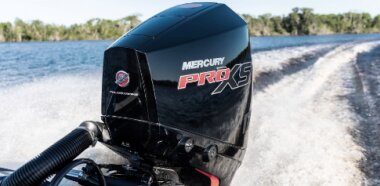
Evinrude 200 ETEC Specifications
| Engine Model: Evinrude E-TEC 200 |
| Engine Type: 2-stroke 6-cylinder gasoline outboard engine |
| Total Displacement: 200.1 cu.in (3.2 L) |
| Rated Engine Power: 200 Hp (148 kW) at 5500 rpm |
| Fuel System: Direct fuel injection (DFI) |
____________________________________________________________________________________
The Evinrude 200 ETEC is a 74-degree V6,
two-stroke outboard engine utilizing Evinrude's proprietary E-TEC direct
fuel injection technology. The engine produces 200 propeller Hp at 5150
to 5500 RPM depending on configuration. The full throttle operating
range is 5400 to 6000 RPM for standard models and 5250 to 6000 RPM for
HO variants. Engine displacement is 3279 cc (200.1 cubic inches),
achieved with a bore of 98 mm (3.86 inches) and a stroke of 73 mm (2.87
inches).
The charging system produces 133 amperes total output with 50 amperes
net dedicated for battery charging and accessory operation. Available
shaft lengths include 20 inches, 25 inches, and 30 inches to accommodate
various transom heights. The gear ratio is 1.85:1 or 1.86:1 depending on
model and year. The engine is designed to operate on standard 87 octane
unleaded fuel and meets EPA, CARB 3-Star, and European Union emissions
standards.
The powerhead is constructed around a 74-degree V6 cylinder block with
loop-charged induction, a configuration that optimizes fuel scavenging
and power production. The bore and stroke dimensions of 98 mm by 73 mm
provide an oversquare design that promotes efficient combustion and
responsive throttle operation.
Unlike conventional two-stroke engines, the E-TEC design eliminates the
need for intake and exhaust valves, relying instead on precisely timed
port openings and advanced direct fuel injection timing to control the
combustion process. The engine management system makes millions of
calculations per second to optimize fuel delivery and ignition timing
for current operating conditions.
The powerhead incorporates the E-TEC direct injection system with
stratified low RPM combustion mode, which creates layers of air and fuel
mixture for ultra-lean operation during trolling and low-speed running.
The ignition system is IDI fast-rise inductive ignition, providing
powerful spark across the entire operating range.
The E-TEC 200 utilizes a high-pressure direct fuel injection system
managed by an electronic control module specifically calibrated for this
application. The fuel system operates in two distinct modes depending on
engine speed and load. Below 1800 RPM, the system employs stratified
combustion, where layers of air and fuel mixture are carefully
controlled with fuel injected via several short-duration sprays into a
pocket in the combustion chamber, achieving overall air-fuel ratios of
40:1 for exceptional fuel economy during trolling and slow-speed
maneuvering.
Above 1800 RPM, where substantially more torque is needed to plane the
hull, fuel injection switches to homogeneous combustion with an air-fuel
ratio of approximately 25:1 but still almost twice as lean as comparable
EFI four-stroke engines. The fuel injection pressure varies between 36
and 50 bar (500 to 700 PSI), increased from the 30 bar (400 PSI) of
earlier Evinrude DI engines. The fuel induction system incorporates an
air silencer designed to prevent moisture entering the air intake, with
the intake specially designed to allow all the air the engine needs to
develop good power with minimum noise.
The E-TEC 200 employs a sophisticated multi-point targeted oiling system
that represents a significant advancement over conventional two-stroke
lubrication methods. The system delivers oil precisely where it is
needed through multiple distribution points, ensuring optimal
lubrication of crankshaft bearings, connecting rod bearings, and
cylinder walls under all operating conditions. A pressure sensor instead
of a simple pressure switch provides sophisticated monitoring
capabilities that can detect any problems in oil flow and lubrication.
If issues are detected, the engine management system places the engine
into S.A.F.E. (Speed Adjusting Failsafe Electronics) mode, allowing the
engine to operate at reduced speed to permit safe return to port. The
recommended lubricant is Evinrude/Johnson XD100 oil, a high-performance
synthetic blend specifically formulated for E-TEC engines.
Evinrude/Johnson XD50 or XD30 can also be used, and if Evinrude/Johnson
brand oils are unavailable, any oil meeting NMMA TC-W3 certification
standards is acceptable.
The oil injection rate is controlled by the Engine Management Module
based on engine RPM, and this rate can be adjusted for the type of oil
being used using Evinrude Diagnostics software. The TC-W3 oil type
setting is the standard setting for all outboards and provides maximum
lubrication for extreme applications, while the XD100 setting provides
an option to run at a reduced oil injection rate but REQUIRES the use of
Evinrude XD100 lubricant. Oil is supplied via a remote tank with
capacities of 10 litres, 3 litres, or 1.8 litres depending on
installation requirements.
The cooling system on the E-TEC 200 is a two-stage, pressure and
temperature-controlled water-cooled design that maintains optimal
operating temperatures across all conditions. The flow of water through
the cylinder block and cylinder heads is controlled by two thermostats
and one external pressure valve. The pressure valve is connected by
hoses to the top of each cylinder head. A rubber-impeller water pump,
driven by the vertical driveshaft within the lower unit, draws water
from external intakes mounted in the gear case housing and provides all
cooling water to the powerhead.
The pump operates as a positive displacement pump at low speeds below
1500 RPM and as a centrifugal pump at higher speeds. At low speed, the
pressure valve is against the seat and the thermostats are closed, with
warm water gradually migrating to the thermostat pocket at the top of
each cylinder head. The thermostat opens when the water temperature
reaches approximately 135 to 143 F (57 to 62 C). At higher speeds above
1200 to 1800 RPM, water pressure increases and opens the pressure relief
valve, allowing water to bypass the thermostats and flow directly
through the cylinder heads to provide high-flow discharge during
high-speed operation.
Two external water supply hoses direct water flow into the exhaust
plenum area of the cylinder block to reduce exhaust runner temperatures,
and a third external water hose directs water flow from the exhaust
housing to an exhaust passage at the adapter to cool inner exhaust and
the propeller hub. Cooling water is also routed from the top of the
cylinder block to cool the Engine Management Module and vapor separator
before exiting through the adapter housing.
| Mid Section and Lower Unit |
The midsection houses the exhaust tuner and connects the powerhead to
the lower unit. The exhaust system through the leg is lined with moulded
plastic rather than bare metal to dampen noise. A muffler with an
idle-relief system eliminates high back-pressure inside the engine when
idling, routing exhaust through relief ports rather than the propeller
hub for quieter operation.
The lower unit contains the forward, neutral, and reverse gears with a
gear ratio of 1.85:1 or 1.86:1. The gearcase is filled with
high-viscosity marine gear lubricant that must be checked periodically
and changed according to the maintenance schedule. The propeller shaft
is supported by heavy-duty bearings capable of withstanding the thrust
loads generated by the 200 Hp output. Sacrificial anodes are located on
the lower unit and engine components to provide galvanic corrosion
protection in saltwater environments.
The Evinrude 200 ETEC is equipped with FasTrak power trim and tilt as
standard equipment. The trim range is negative 4 deg to positive 17 deg,
allowing fine adjustment of engine angle for optimal hull performance
under varying load and water conditions. The tilt range is 75 deg,
providing complete out-of-water positioning for trailering, mooring, or
servicing.
The system allows the operator to adjust engine angle dynamically while
underway, optimizing hull performance by modifying the propeller thrust
angle relative to the water surface. Regular inspection of the trim and
tilt system is included in the maintenance schedule.
0Propeller selection for the E-TEC 200 must allow the engine to operate
within its specified full-throttle RPM range when the boat is normally
loaded. The engine utilizes propellers with a spline configuration
matching the gearcase. During documented testing on an Intercoastal 23,
a 19-inch pitch stainless steel propeller provided excellent
performance.
Stainless steel propellers are commonly preferred for their durability
and performance characteristics. The propeller nut must be tightened to
70 to 80 lb-ft (95 to 109 Nm) and secured with a cotter pin. If the
cotter pin holes in the propeller nut and propeller shaft are not
aligned, the nut must be tightened further until alignment is achieved
rather than loosened to align.
The Evinrude 200 ETEC offers weight advantages over comparable
four-stroke engines of similar power output. The engine weight varies by
model and shaft length, ranging from approximately 231 to 238 kg for the
HO 200. Other specifications list weights from 418 lbs (190 kg) to 558
lbs (253 kg) depending on configuration and source. The 2016 HO model
with 20-inch shaft weighs 518 lbs (235 kg). The physical dimensions
reflect the 74-degree V6 configuration, with transom heights available
in 20 inches (508 mm), 25 inches (635 mm), and 30 inches. The idle speed
is an exceptionally low 500 RPM, placing it ahead of competitors'
engines that idle at 700 to 750 RPM.
The Evinrude E-TEC 200 is designed with remarkably simplified
maintenance requirements. For recreational users, no scheduled dealer
maintenance is required for three years or 300 hours of operation,
whichever occurs first. This includes no requirement for spring
tune-ups, no gearcase lubricant changes during this period, and no oil
changes whatsoever as the engine is a two-stroke design.
The spark plugs are special low-voltage platinum-tipped rivet types
designed to reduce electrode erosion for better reliability and extended
service life. The engine features an idle air bypass system that closes
the throttle plates at idle and diverts air through a tube below 1500
RPM, further reducing noise.
The lubrication system uses a pressure sensor instead of an oil pressure
switch to detect any irregularities and protect the engine. With
significantly fewer moving parts than four-stroke alternatives, the
E-TEC design inherently reduces wear and maintenance requirements.
The recommended service after the initial period includes inspection of
anti-corrosion anodes annually in saltwater applications, replacement of
the fuel filter, gearcase lubricant replacement, lubrication of grease
fittings and propeller shaft splines, and water pump inspection. The
engine features a break-in period that requires no special operator
procedures, as the engine management system provides additional oil
during the first hours of operation.
The propeller nut requires 70 to 80 lb-ft (95 to 109 Nm) of torque and
must be secured with a cotter pin with ends bent to secure. The flywheel
nut requires 100 to 115 lb-ft (136 to 156 Nm) of torque to ensure the
flywheel remains securely seated on the crankshaft taper under all
operating conditions.
Cylinder head screws require 168 to 192 lb-in (14 to 16 lb-ft) of
torque. Main bearing screws are critical fasteners that secure the
crankshaft main bearings. These bolts must be torqued to 48 to 52 lb-ft.
Injector retaining screws require 24 to 26 lb-ft of torque. Engine
mounting bolts that secure the outboard to the transom must be tightened
to 40 lb-ft. The trim tab screw requires 35 to 40 lb-ft of torque.
Spark plugs are installed at 10 to 15 lb-ft. This torque value ensures
proper compression sealing while providing adequate heat transfer from
the spark plug to the cylinder head. Correct torque also prevents thread
damage in the aluminium cylinder head. The thermostat cover screws
require 120 to 144 lb-in (13.6 to 16.3 Nm) of torque.
The Evinrude E-TEC 200 is ideally suited for a wide range of boat types
requiring reliable power with enhanced fuel efficiency and minimal
maintenance. The engine performs exceptionally well on fibreglass
runabouts, centre console fishing boats, performance hulls, and larger
aluminium craft.
The standard engine model, up-rated from smaller displacement engines,
proves ideal for lightweight ski boats and performance hulls where its
power-to-weight ratio provides distinct advantages.
____________________________________________________________________________________
| Outboard Engines Technical Specifications |
| Small Engines Technical Specifications |
| Car Engines Technical Specifications |
| Industrial Engines Technical Specifications |